Like so many Greek islands, Rhodes is an island lined with millennia of archaic relics. In a way, history is woven into every stone, street, and landscape, offering visitors a journey through more than three thousand years of human settlement and culture. Situated at the crossroads of the Aegean and eastern Mediterranean, it has long been prized for its strategic position and natural harbours.
The island’s historic sites offer something for every kind of visitor. Ancient Greek and Hellenistic ruins reveal the sophistication of urban planning more than two thousand years ago. Stepping through these sites, you can almost imagine what life was like here. Roman and Byzantine remains, including the island’s stadiums, odeons, and early churches, further illustrate how Rhodes evolved over time.
However, the history of Rhodes goes back even further. It all began in the Bronze Age, when Mycenaean Greeks established early settlements along rugged coasts and took advantage of the fertile plains. By the 6th century BC, Rhodes had grown and had three great cities, Lindos, Kamiros, and Ialysos, each flourishing independently before uniting in 408 BC to form the city of Rhodes, a new urban centre on the northern tip of the island. These ancient foundations left a legacy of acropolises, temples, and agoras that can still be explored today.
Following the Hellenistic period, Rhodes became a hub of Roman influence, integrating imperial architecture, public buildings, and entertainment spaces such as stadiums and odeons into its urban fabric. The decline of Roman authority brought the Byzantine Empire from the 4th century onwards. Christianity spread, fortifications were reinforced, hilltop refuges established and small churches constructed across the countryside, often close to villages, springs or agricultural land. Many of these churches were modest in scale, built to serve local communities rather than imperial ambition, yet they played a vital role in preserving Orthodox faith and identity through eras of upheaval.

The island’s strategic location made it a prize for successive conquerors. In 1309, the Knights of St John established their headquarters on Rhodes, transforming the island into a heavily fortified crusader stronghold. Over two centuries, they built the Medieval Old Town, the Palace of the Grand Master, hilltop castles, and a network of bastions and watchtowers that combined military ingenuity with architectural elegance. The Knights’ influence shaped Rhodes’ political, cultural, and urban landscape in ways that remain remarkably visible today.
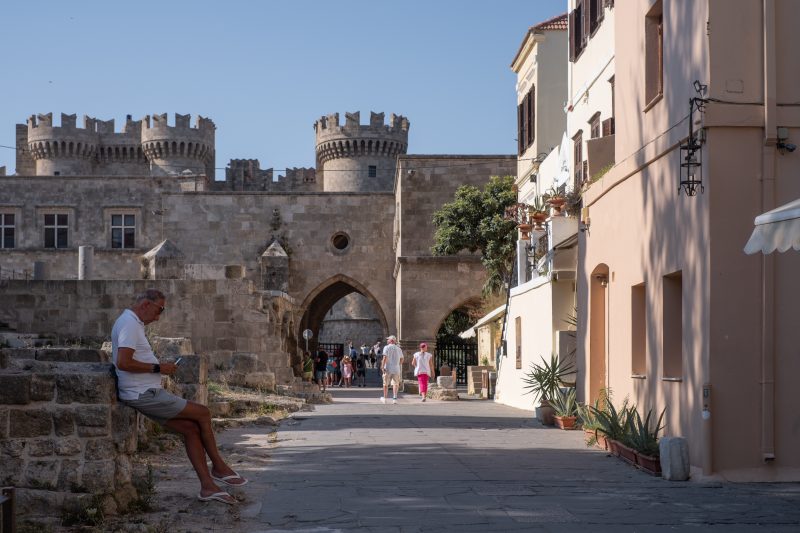
The UNESCO-listed Medieval Old Town of Rhodes is probably the island’s most visited sights, and somewhere that anyone arriving on the island should head towards. The Gothic streets, walls, and gates remain largely intact, offering a rare chance to walk through a living monument to European medieval culture.


In 1522, Rhodes fell to the Ottomans, who maintained the city’s fortifications while introducing Islamic architectural elements such as mosques, baths, and fountains. Despite these changes, much of the medieval and Byzantine buildings were preserved, creating the layers of history. Later, during the Italian occupation in the 20th century, restoration projects aimed to conserve both classical and medieval monuments, further safeguarding the island’s heritage.
It is because of all of this that visiting Rhodes is like seeing a living chronicle of Mediterranean history. Its historical sites reveal not only military and political events, but the daily lives, beliefs, and artistry of the people who inhabited the island over millennia. If you’re seeking to combine scenic beauty with deep historical insight, Rhodes provides an extraordinary tapestry of experiences that is unmatched in the Aegean. Here are my favourite, must-visit sights on the island.
Medieval Rhodes: The Island of the Knights
From the extensive collections of the Archaeological Museum of Rhodes to smaller arts and folklore museums scattered across towns and villages, these institutions preserve everything from intricate Hellenistic mosaics and Roman sculptures to Byzantine icons and traditional crafts.
The Medieval Old Town of Rhodes (UNESCO World Heritage Site)
There isn’t much chance you would come to Rhodes’ and not pay a visit to the astonishing Old Town. Encircled by massive stone walls, deep defensive moats, and designated a UNESCO World Heritage Site, this Medieval gem stands as one of the most complete and compelling fortified cities in Europe, and is a living monument to the island’s strategic importance at the crossroads of the Mediterranean.

The Old Town took its definitive form under the Knights of St John, who ruled Rhodes from 1309 to 1522 and transformed the city into a formidable crusader stronghold. Their defensive system, made up of a sophisticated network of walls, bastions, gates and moats, remains largely intact, which is a testament to the military engineering of the late medieval period. It’s a good idea to walk the perimeter, particularly near gates such as St Athanasios, St John and d’Amboise, which reveal how the city was designed to withstand prolonged attack.

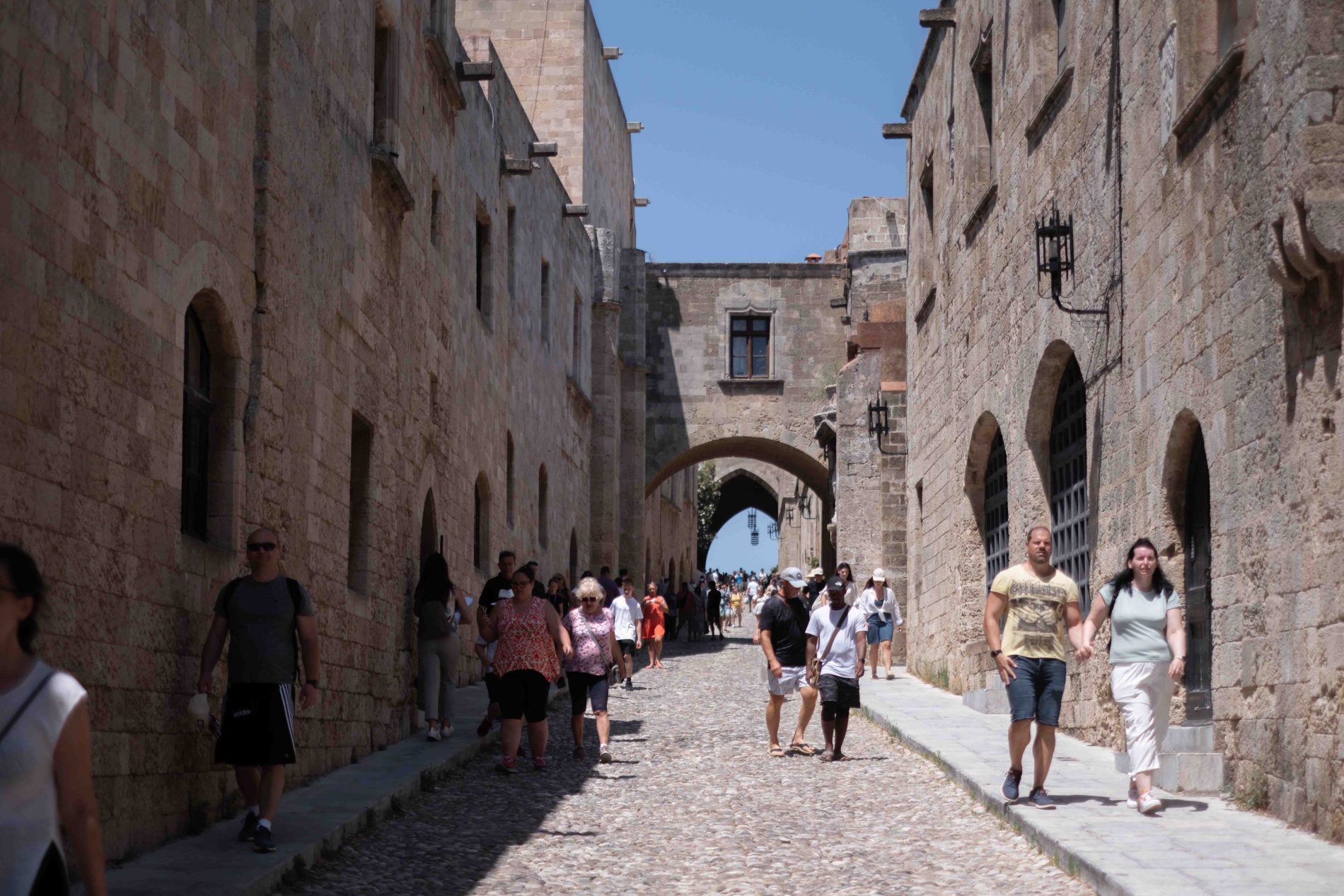
Within the walls, the city is divided into quarters. The Street of the Knights is the most iconic, a steep cobbled avenue lined with the former inns of the Knights’ European langues, each a self-contained residence that shows the order’s international character. At its summit stands the Palace of the Grand Master, a monumental fortress/palace that served as both administrative centre and last line of defence. Nearby, you’ll find Gothic churches, hospitals and administrative buildings.
Yet, the Old Town is not solely Medieval. Following the Ottoman conquest in 1522, new buildings were added while keeping much of what came before. Mosques such as the Süleyman Mosque, fountains, baths and timber-fronted houses introduced Islamic architectural elements and reshaped the city’s appearance. The Jewish Quarter, with landmarks such as the Kahal Shalom Synagogue, reflects centuries of coexistence and commercial exchange, adding further depth to the Old Town’s cultural fabric.

A real joy is walking its streets and seeing how these different layers coexist in close proximity. Byzantine foundations sit beneath Gothic halls, and Ottoman domes or minarets rise beside crusader streets. Nowadays, modern cafés and shops occupy spaces once used for defence.
If you want to explore the old town at its best, early mornings and evenings are ideal. This allows you to wander at a leisurely pace without the crowds who arrive during the day on group tours or from the cruise ships docked in the harbour. Just before sunset is my favourite, when the sunlight softens across façades, and the local bars and restaurants begin to buzz.
Palace of the Grand Master of the Knights of Rhodes
Where: Epar. Od. Monolinthou-Frourio Monolinthou 89, Monolithos 851 08, Greece
When: Daily 8am – 7pm
Dominating the highest point of the Medieval Old Town, the Palace of the Grand Master of the Knights of Rhodes stands as the most powerful symbol of the island’s crusader past, its vast walls and towers projecting authority over the city below. Part fortress, part administrative centre and part ceremonial residence, the palace was the heart of the Knights of St John’s rule on Rhodes, embodying both their military ambition and their vision of Rhodes as a Christian stronghold in the eastern Mediterranean.

Where the palace now stands was originally the site of an earlier Byzantine citadel. As the headquarters of the Order, it housed the Grand Master and served as the focal point of governance, diplomacy and defence. From here, strategies were devised to protect the island from repeated Ottoman assaults, culminating in the famous siege of 1522, after which the Knights were forced to abandon Rhodes.


Massive stone walls, crenellated towers and fortified gates emphasise its defensive function, while inside, vast halls and courtyards give it a more ceremonial feel. Much of the structure seen today reflects Italian-era reconstruction carried out in the early 20th century, following severe damage caused by an explosion in 1856.


Although the exterior is impressive, it’s worth stepping inside, where you’ll encounter a sequence of grand spaces that convey the prestige of the Order. The upper floors, which were originally part of ancient villas, house galleries displaying Hellenistic and Roman mosaics recovered from across Rhodes. Elsewhere, reconstructed chambers, armorial displays and period furnishings tell the stories of knightly life.
Ancient Greek and Hellenistic Sites in Rhodes
The ancient Greek and Hellenistic sites of Rhodes reveal an island that was once among the most influential cultural and political centres of the eastern Mediterranean. From the sacred acropolis of Lindos to the carefully planned city of Kamiros they are the perfect way to experience a past society that was shaped by maritime power, intellectual life and sophisticated urban design.
Acropolis of Lindos
Where: Acropolis of Lindos, Lindos 851 07, Greece
When: Daily from 8am to 8pm during the summer months (April to October) and from 8.30am to 3.30pm during the winter months (November to March)
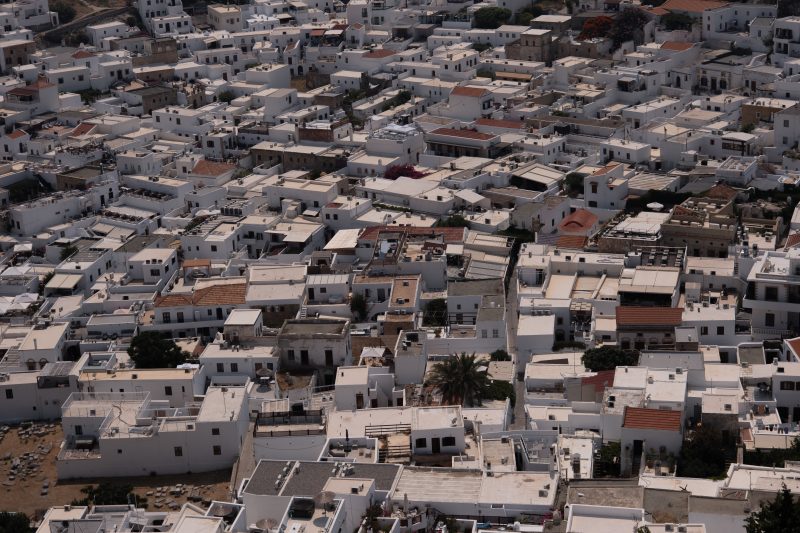
Set beneath one of the most commanding ancient citadels in the Aegean, the village of Lindos and its acropolis form one of Rhodes’ most attractive landscapes, where architecture, archaeology and a traditional town are combined into one of the island’s most appealing day trips. Approached from the coast, the contrast is immediate: Lindos’ dense cluster of whitewashed houses spill down the hillside, while above it the Acropolis sits on bare rock, its ruins silhouetted against sky and sea.

Lindos has been an important settlement since antiquity and was one of the three great ancient city-states of Rhodes, flourishing from the 6th century BC onwards. Sitting high on a rocky outcrop, the Acropolis served as both a religious and defensive centre. Its most significant monument is the Temple of Athena Lindia, originally built in the archaic period and later reconstructed during the Hellenistic era. However, the site offers a fair bit more than just the ruins of this temple: Around it lie the remains of stoas, walls and fortifications, later overlaid with Byzantine and medieval structures, including a castle built by the Knights of St John.


The ascent to the Acropolis can be a little daunting, especially at the height of summer. A steep path winds up from the village, once paved with engraved reliefs dedicated by ancient worshippers. At the summit, the reward is twofold: the archaeological remains themselves and the extraordinary views over St Paul’s Bay and the surrounding coastline, which is one of the reasons why Lindos is one of the island’s most visited destinations.
Below, the village itself presents a rare example of traditional Rhodian architecture preserved almost intact. The winding, tightly-packed streets and alleyways are inaccessible by car, so remain traffic-free and a real pleasure to wander for a few hours. Its houses are characterised by flat roofs, pebble-mosaic courtyards, and carved stone details. Many date from the period of Ottoman rule, when Lindos prospered as a maritime and trading community. The narrow lanes lead to shaded squares, small churches and some wonderful viewpoints where glimpses of the Acropolis or coastline reappear between rooftops.
Ancient Kamiros
Where: Kameiros 851 06, Greece
When: Daily 8am – 7pm
Kamiros was one of the three great ancient city-states of Rhodes (alongside Lindos and Ialysos), flourishing from the 6th century BC before its gradual decline and eventual abandonment, likely following a series of earthquakes in the Hellenistic period. Unlike Lindos, which continued to grow and evolve through medieval and modern eras, Kamiros was never rebuilt, leaving behind an unusually intact snapshot of an ancient Greek city. This abandonment is precisely what makes the site so distinctive: the layout is exactly as it was left, with no later layers to obscure it, and only stone foundations tracing streets, homes and civic spaces remaining.

The city is laid out across three main terraces, descending towards the sea. At the upper level lie what is left of a small acropolis and temple, while the middle terrace contains the agora and public buildings. Below, residential quarters are laid out in neat rows, with houses arranged along a grid of streets. The cisterns and water-management systems are particularly striking, giving evidence of the sophisticated urban planning that was adapted to Rhodes’ dry climate. There aren’t many monumental temples or grand statues left here, but Kamiros is the perfect place to explore how people lived in antiquity.


There is little shade and wide views across the coastline, making the site feel exposed to the elements, much as it would have been in its heyday. The lack of crowds enhances this effect, allowing you to take your time when viewing the ruins, pausing to piece together the ins and outs of ancient civic life.
Reaching Kamiros is easiest by car, via the west coast road, and the site is easily combined with exploration of nearby villages or coastal viewpoints. The facilities here are fairly good: You’ll find a cafe and toilets, but make sure that you still bring water, sun protection and sturdy footwear. The terrain is relatively gentle compared to hilltop sites like Lindos, but more walking is needed here to traverse the site fully.
Filerimos Hill and the Ancient City of Ialysos
Where: Filerimos Hill, Ialyssos, Rhodes, 85101
When: Daily during summer (April-October) 8am – 7pm or 8pm; Winter (November-March) 8.30am to 3pm
On the west coast, near modern Ixia, Filerimos Hill and the ancient city of Ialysos ia place where ancient cults, early Christianity and medieval occupation intersect within a compact historical site. It’s less dramatic than both Lindos and Kamiros but is worth visiting if you want to complete your understanding of the island’s complex past.
It thrived from the Mycenaean period through the archaic and classical eras. In antiquity, the settlement extended from the slopes of Filerimos Hill towards the coast, acting as both a religious centre and an active port community. The hill itself formed the city’s heart, crowned by temples dedicated to Athena Polias and Zeus; however, only the foundations survive today, along with some fragmentary walls.
What makes Filerimos interesting is the accumulation of religious structures that were built here. In the early Christian period, basilicas were built atop or alongside pagan sanctuaries. During the medieval era, the Knights of St John established a monastery on the hill, dedicating it to Our Lady of Filerimos, an icon still associated with the site. The complex was later restored during Italian rule in the 20th century, when landscaped paths and devotional elements were added, shaping much of its present appearance.
Roman and Byzantine Remains Worth Visiting
The Roman and Byzantine remains of Rhodes mark a period of transition, when the island evolved from a Hellenistic power into a key outpost of the Christian eastern Mediterranean. Structures such as the impressive ancient stadium and odeon reflect Roman investment, while Byzantine churches, fortifications and early basilicas tell the story of centuries of spiritual continuity.
Ancient Stadium and Odeon of Rhodes
Where: 68 Diagoridon str, Rhodes 85100
When: Accessible 24/7 with free entry, as they are part of an open archaeological park, though specific official hours might vary for any adjacent buildings or guided tours
Just beyond the medieval walls of Rhodes Old Town, on the lower slopes of Monte Smith Hill, the Ancient Stadium and Odeon of Rhodes offer a rare glimpse into the island’s civic and cultural life during the Hellenistic and Roman periods. Quite a lot of visitors to the island’s capital don’t make it here, either opting to confine their exploration to the main Medieval complex and overlooking it in favour of grander landmarks. However, these ruins nonetheless reveal how ancient Rhodes functioned not only as a fortified city and trading power, but as a place of culture and public gathering.
The stadium and odeon formed part of a wider public complex created after the founding of the city of Rhodes in 408 BC, when the three ancient city-states united to establish a new capital. During the Hellenistic era, Rhodes became renowned for education and athletic competition, and these structures played a central role in civic life. The stadium was used for athletic contests and training, while the odeon (a smaller, roofed theatre) hosted musical performances, lectures and rhetorical displays.
Today, the Ancient Stadium is among the best-preserved in Greece. Its track remains clearly defined, with starting blocks still visible, allowing visitors to imagine athletes lining up for races more than two millennia ago. Nearby, the Odeon has been partially reconstructed, its semicircular seating rising above the orchestra space.. From nearby viewpoints on Monte Smith Hill, panoramic views extend across the city, the harbour and the coastline, linking the site visually to the wider ancient urban landscape.
Access is pretty straightforward, making this an ideal stop if you want an introduction to Rhodes’ ancient sites but are short on time. The stadium and odeon can be reached on foot from Rhodes Old Town or by a short drive, with parking available nearby.
Byzantine Churches and Fortifications
Scattered across Rhodes, often in places where modern development has barely reached, the island’s Byzantine churches and fortifications offer a more introspective and remote encounter with history. Unlike the grand acropolises or the imposing castles of the Knights of St John, these sites reflect the long centuries in which Rhodes existed as a Christian island at the eastern edge of the Byzantine world.

Architecturally, Rhodes’ Byzantine churches are relatively simple and restrained. Most are single-nave structures with stone walls, tiled roofs and minimal external decoration. However, they are often beautiful on the inside rather than out. Within, traces of fresco cycles cover the walls, depicting images of Christ Pantocrator, the Virgin Mary, saints and martyrs, that are still expressive despite the fact that they have faded with time. These paintings, often dating from the 11th to 15th centuries, provide invaluable insight into regional artistic traditions and devotional practices.


Some of the most evocative examples survive in rural areas and smaller settlements, where churches were less likely to be rebuilt or heavily restored. Here, faded frescoes coexist with agricultural landscapes, reinforcing the close relationship between faith and daily life. In many cases, these churches remain active, opened on feast days or for local services, maintaining traditions that stretch back nearly a millennium.
In Rhodes Old Town, elements of the later medieval walls incorporate Byzantine foundations, while the 11th-century church of Panagia tou Kastrou stands as the clearest surviving example of Byzantine ecclesiastical architecture within the city.

Alongside these religious buildings, remnants of Byzantine defensive architecture can still be found woven into Rhodes’ later fortifications. In Rhodes Old Town, parts of the medieval walls incorporate earlier Byzantine foundations, while in the countryside, ruined watchtowers and hilltop enclosures mark former lines of defence. These locations emphasise how Byzantine Rhodes relied on networks of observation and retreat rather than monumental fortresses.
Castles, Fortresses and Defensive Sites
Rhodes’ castles, fortresses and defensive sites trace the island’s long history as a strategic stronghold. From remote hilltop citadels like Monolithos and Kritinia to fortified positions embedded within later settlements, these structures were designed to protect vulnerable coastlines and provide refuge in times of attack.
The Castle of Monolithos
Where: Epar.Od. Monolinthou-Frourio Monolinthou 89, Monolithos 851 08, Greece
When: Open 24/7
Clinging dramatically to a sheer rock above the southeast coast of Rhodes, the Castle of Monolithos is one of the island’s most striking historical sites. Seen from below, the fortress appears almost inseparable from the monolith on which it stands as it rises abruptly above pine forests and the Aegean.
The castle was built in the 15th century by the Knights of St John, during a period when Rhodes faced constant threat from Ottoman expansion and pirate raids. Its position was chosen because the rock is isolated, steep-sided and naturally defensible, making large-scale assault virtually impossible. From here, the Knights could monitor the surrounding coastline and inland routes, using the fortress as both lookout and last refuge. The name Monolithos, or ‘single stone’, perfectly describes the geological feature on which it sits.

Today, much of the original structure is now in ruins, but the remains are enough to convey its purpose. Fragments of walls, battlements and a small chapel dedicated to Saint Panteleimon still survive, and their weathered stone blends seamlessly into the rock. The views are an essential part of the experience. From the top, the landscape unfolds in all directions, from rugged hills and dense forest to scattered beaches and the open sea.
Reaching the Castle of Monolithos requires a short but memorable approach. The site is best accessed by car, following coastal or inland roads to the small parking area at the base of the rock. From there, a steep footpath and stone steps lead upward through trees and rocky terrain. The climb is brief, typically 10 to 15 minutes, but uneven underfoot. There are no facilities at the top, so water and sun protection are advisable, particularly in warmer months.
The Castle of Kritinia
Where: Epar.Od. Ialisou-Katavias 15, Siana 851 08, Greece
When: Open 24/7
Another castle that sits high above Rhodes coastline, Kritinia is another commanding reminder of the island’s medieval frontier, its weathered walls looking out across the Aegean towards the distant outline of Halki. The ruins are less dramatic than Monolithos at first glance; however, Kritinia is still impressive in terms of scale and position.


Similar to the previous entry on this list, the castle was constructed in the 15th century by the Knights of St John during the same turbulent period that saw the strengthening of Rhodes’ coastal defences. Built on the site of earlier fortifications, Kritinia formed part of a chain of castles designed to protect the island’s western approaches and to provide early warning of enemy fleets.
Although now partially ruined, the surviving structures still communicate the castle’s original purpose. Sections of outer walls, towers and internal divisions remain visible, and within the enclosure lie the remains of chapels dedicated to Saint John and Saint Paul.

Again, this castle is best reached by car, following signs from the village of Kritinia along a narrow road that climbs towards the ridge. A small parking area lies close to the entrance, from which a short, gently sloping path leads to the ruins, which is less demanding than the ascent to Monolithos.
Archaeological Museums and Cultural Highlights
From the extensive collections of the Archaeological Museum of Rhodes to smaller decorative arts and folklore museums scattered across towns and villages, Rhodes’ museums preserve everything from intricate Hellenistic mosaics and Roman sculptures to Byzantine icons and traditional crafts.
Rhodes Archaeological Museum
Where: Akti Sachtouri 8, Rodos 851 00, Greece
When: Daily 8am – 8pm
Housed within the monumental Hospital of the Knights in Rhodes Old Town, the Archaeological Museum of Rhodes gathers together an extraordinary collection of artefacts from the island’s ancient past within one of its most important medieval buildings. Set on Museum Square, the huge Gothic complex was constructed in the 15th century by the Knights of St John with grand halls and cloistered courtyards that have now been repurposed to safeguard Rhodes’ heritage.

The museum’s collections span the full breadth of ancient Rhodian history, from the Mycenaean period through the Hellenistic and Roman eras. Among the most striking exhibits are marble statues discovered across the island, including the celebrated Aphrodite of Rhodes, which is a brilliant example of the island’s reputation for refined Hellenistic sculpture. Funerary monuments and grave reliefs give a more personal insight, depicting moments of family life, athletic achievement and civic pride, while the inscriptions provide valuable evidence of Rhodes’ political and social organisation.

Several galleries are dedicated to artefacts recovered from some of the major archaeological sites such as Lindos, Kamiros and Ialysos, mentioned elsewhere on this list, allowing you to connect the museum’s displays directly with other parts of the island. You’ll also find Intricately decorated ceramics, jewellery and everyday objects, as well as votive offerings from sanctuaries like the Temple of Athena Lindia, which highlight daily life and the religious practices of the people that once lived here.
Decorative Arts and Minor Museums
Beyond Rhodes’ main attractions, there are a number of small art collections and minor museums that add more niche details to the land’s historical story, often giving a detailed picture of how residents lived, worked and expressed their own identity across the centuries. These smaller museums may not be as impressive as the Archaeological Museum or the Palace of the Grand Master, but they help round out the story of the island’s past.
Within Rhodes Old Town, the Museum of Decorative Arts is housed in a restored medieval building, showcasing textiles, ceramics, metalwork and domestic objects from a long tradition of craftsmanship and trade. You’ll find embroidered costumes, jewellery and household items influenced of Ottoman, Venetian and local Greek occupations.
Several specialised museums focus on particular aspects of the island’s past. The Jewish Museum of Rhodes, set within the historic Jewish Quarter, delves into the once-thriving Sephardic community that shaped Rhodes’ commercial and cultural life from the Ottoman period until the Second World War. Through photographs, documents and ritual objects, the museum adds an essential layer to understanding the island’s multicultural history. Elsewhere, folklore collections in villages such as Archangelos preserve traditional dress, woodworking tools and musical instruments, connecting historical narratives to living local identity.
Artistic expression also finds a place in these smaller institutions. Galleries dedicated to icon painting and ecclesiastical art highlight the evolution of Orthodox visual traditions, while exhibitions of post-Byzantine icons reveal regional variations often overlooked in larger museums.
Monasteries and Churches
From hilltop sanctuaries like Tsambika and Filerimos to hidden village chapels and Byzantine churches, Rhodes’ historic religious sites combine spiritual significance with stunning locations, often overlooking the sea or the countryside. Rich in frescoes, icons, and architectural detail, they reflect Orthodox devotion as well as later influences from the medieval and Ottoman periods.
The Monastery of Panagia Skiadeni
Where: Μεσαναγρος, South Rhodes 851 09, Greece
When: Daily 8am – 8pm
Tucked away in the hills of Rhode’s rural south, Panagia Skiadeni stands alone amongst the peaks of the island’s rocky interior. It’s far removed from the busier sights of Lindos or Rhodes Old Town; this modest religious complex sits amid lightly wooded hilltop and agricultural land, its secluded setting reflecting its original role as a place of retreat and contemplation. You’ll need a car to get here, but in a way, this makes the journey here feel purposeful, leading away from the coast into a landscape that has remained largely unchanged over generations.

The monastery is believed to have Byzantine origins, with subsequent phases of construction and restoration during the Ottoman period and into modern times. Like many rural monasteries on Rhodes, Panagia Skiadeni served multiple roles: a centre of worship, a focal point for surrounding villages, and at times a place of refuge during periods of unrest, piracy or conflict. Dedicated to the Panagia, or Virgin Mary, it forms part of the island’s Orthodox tradition, where Marian devotion has been a focal point of religious and communal life. The origin of the name Skiadeni remains uncertain, likely tied to local place names or natural features rather than a specific historical figure.


At its heart is a small stone-built church, constructed in local style and free from the ornate flourishes associated with imperial Byzantine centres. Inside, post-Byzantine frescoes, faded with time but still impressive, depict familiar Orthodox themes, including Christ Pantocrator, scenes from the life of the Virgin, and a host of saints venerated across the island. The surrounding buildings, still used as monks’ cells and for practical purposes, are simple and functional, reinforcing the sense of Panagia Skiadeni as a lived-in, working place of faith rather than a restored monument just for tourists.

On religious feast days, villagers continue to gather here for services and celebrations, transforming the complex into a centre of communal memory. Visit on any other day, and you will find it almost empty, other than the monks that mill around and quite a large community of cats that are looked after by the religious faithful that reside here. Kindly, the monks lay out pots of urns of tea and biscuits for visitors, and there’s a small shop if you want to make a purchase and contribute to the upkeep of the monastery.
Tsambika Monastery
Where: Archangelos 851 02, Greece
When: Daily 8am – 8pm
Rising high above the east coast of Rhodes, sandwiched between Kolymbia and Archangelos, Tsambika Monastery is one of the island’s most striking landmarks. It’s Visible from miles away, a whitewashed chapel crowning a steep, rocky hill overlooking Tsambika Beach and the Aegean. It’s this isolation, and the effort it takes to reach it, that lends the place a powerful sense of pilgrimage.
Tsambika is dedicated to the Virgin Mary, and the monastery is among the most important Marian shrines on Rhodes. According to local tradition, the story of Tsambika begins with a miraculous icon of the Panagia that was said to have travelled from Cyprus, guided by a mysterious flame (tsamba in local dialect), which appeared repeatedly on the hilltop. When the icon was finally recovered, a chapel was built on the spot, giving rise to the monastery.


Uniquely, Tsambika exists as two related religious sites. At the foot of the hill stands the Lower Monastery of Panagia Tsambika, an active convent surrounded by gardens and shaded courtyards. This is where you will first encounter the site and where services are held more regularly. Above it, reached by climbing a daunting 300 stone steps, is the Upper Monastery, a small chapel perched dramatically at the summit. The ascent is sweaty work, particularly in summer heat, but the reward is one of the most expansive views on the island, stretching across the coastline and deep into the interior hills.


Tsambika is especially renowned for its association with fertility and childbirth. For generations, women hoping to conceive have made pilgrimages to the monastery, praying to the Virgin Mary and, in some cases, promising to name their child Tsambikos or Tsambika in gratitude, names still commonly heard on Rhodes today. I’m not sure if it is related, but visitors hang trinkets and rosaries from the branches of the trees surrounding the monastery.
Although the view from the peak is spectacular, the hilltop chapel itself is small and austere, while the lower monastery reflects traditional monastic design, which is functional and welcoming rather than impressive.


Getting to Tsambika Monastery is relatively straightforward, despite being so high above the surrounding landscape. However, it does require a little planning, particularly if you wish to reach the upper chapel. The Lower Monastery of Panagia Tsambika is easily accessed by car and lies just off the main coastal road, with clear signage and a small parking area nearby. Public buses along the east coast can bring you close, but the final approach is on foot, making a car the most convenient option. From the lower monastery, those wishing to visit the Upper Monastery must climb the steep stone steps. The ascent typically takes 20–30 minutes, depending on pace, and sturdy footwear, water and sun protection are essential, especially in warmer months. The effort may be considerable, but the sweeping views over the coast and countryside, as well as the friendly local goats, make the journey an integral part of the experience.
The monastery is most evocative in the early morning or late afternoon, when the heat is a little softer, and the light casts long shadows across the hills and sea. Sunset is a spectacular time to visit. It is also at its most vibrant on 8 September, the Feast of the Nativity of the Virgin Mary, when pilgrims gather from across the island.
Panagia tou Kastrou
Where: M. Alexandrou Square, Medieval Town, Rhodes 85100, Greece
When: Wednesday to Monday 8.30am to 3.30pm; Closed Tuesdays
Unlike the other, more remote churches mentioned in this list, you’ll find Panagia tou Kastrou deep within the fortified heart of Rhodes Old Town. It’s one of the city’s most historically layered and compelling religious sites, where centuries of worship have unfolded against a backdrop of conquest, coexistence and cultural exchange.
Panagia tou Kastrou is considered the oldest surviving church in Rhodes Old Town, with origins dating back to the 11th century, during the Byzantine period. Its name translates as “Our Lady of the Castle,” a reference to its location within the fortified city. Over the centuries, the church has undergone multiple transformations, reflecting each era of Rhodes’ complex history. Under the Knights of St John, it was converted into a Latin Catholic cathedral, while following the Ottoman conquest, it became a mosque, known as Enderum Mosque, complete with the addition of a minaret.

Architecturally, the building bears the marks of each of these successive identities. Byzantine foundations sit alongside Gothic elements introduced by the Knights, while Ottoman features remain visible despite later restorations. Inside, traces of medieval frescoes coexist with architectural adaptations from its time as a mosque, creating a layered interior that mirrors the broader history of Rhodes itself.
In the 20th century, during Italian rule, the building was restored and secularised, eventually becoming an exhibition space used for cultural displays and temporary exhibitions. Today, it functions primarily as a monument rather than an active church, but its spirituality resonates.
Practical Tips for Visiting Historical Sites in Rhodes
Although exploring Rhodes’ historical and ancient sites is immensely rewarding and can be a real highlight of your time on the island, they are relatively spread out and so a little planning goes a long way. The island’s archaeology is spread across diverse terrain, from fortified hilltops to sun-exposed coastal ruins, and conditions can vary significantly depending on season and location.
Choose the right time of year
The best months for visiting Rhode’s sites are April to early June and September to October, when temperatures are warm rather than oppressive, and the majority of major attractions are quieter. During these shoulder seasons, sites such as Lindos Acropolis and Rhodes Old Town can be explored at a relaxed pace, without the intense heat or peak-summer crowds. July and August are still viable options, but early morning or late-afternoon visits are essential, particularly since most of these places are exposed with very little shade.
Plan your days around the heat
As mentioned above, Many of Rhodes’ most impressive ruins, such as Kamiros, Monolithos Castle and Lindos Acropolis, offer minimal shelter. It’s best to start your day early, with the aim to finish outdoor sites by midday. Reserve museums or long lunches for the hottest hours.
Wear appropriate footwear and clothing
Uneven stone paths, steep ascents and slippery marble are common at ancient and medieval sites. Sturdy, closed-toe footwear with good grip is far more practical than sandals. Lightweight, breathable clothing, a wide-brimmed hat and high-SPF sunscreen are essential for comfort, particularly in summer.
Carry Essentials
Facilities at archaeological sites can be limited or in some cases, non-existent. Make sure that you’re always carrying water and snacks, especially when visiting rural locations like Ancient Kamiros or Monolithos.
Consider guided tours for additional context
While everywhere on the above list is accessible independently, and information about what you’re seeing is found on boards and signs at most sites, guided tours can greatly enhance understanding, particularly in Rhodes Old Town. Knowledgeable guides can be a great way to gain a deeper insight into the many layers of this island’s history, from antiquity to the Knights of St John. Audio guides are also available at some major attractions. Here’s a selection of some of the best tours:
Tickets, passes and entry fees
Some archaeological sites are included in combined tickets, offering better value if you plan to visit multiple locations. Admission fees vary wildly between attractions and can range from just a few Euros to much higher than expected (I was surprised to have to pay €20 to visit Lindos Acropolis). Many places offer reduced entry for EU students and free access on selected national heritage days. Keep cash on hand, as smaller sites may not accept card payments.
How Many Days Do You Need to Explore Rhodes’ History
The amount of time needed to explore Rhodes’ history depends on how deeply you want to engage with the island’s past and how far you are willing to travel. While it is possible to see the highlights in a short visit, a week would be ideal to allow you the time to move between the main sites, experience its lesser-known archaeological and medieval attractions, while still giving yourself plenty of time to relax and enjoy the island’s beaches.

If you only have one day, just concentrate on Rhodes Old Town as it’s one of the most historically dense areas in Greece. A morning walk along the medieval walls, followed by the Street of the Knights and the Palace of the Grand Master, provides a basic overview of the island’s medieval period. If time allows, stop in at the Archaeological Museum of Rhodes to add some additional ancient context.
A couple more days will give you time to delve a bit deeper. One full day can still be dedicated to Rhodes Old Town and its museums. A second day is best spent visiting the Acropolis of Lindos, combining a few hours in the town with a climb up to the ancient ruins with sweeping coastal views. On the third day, travel west to Ancient Kamiros, one of the island’s most complete archaeological sites, followed by the Ancient Stadium and Odeon near Rhodes Town.


With five days or more, you can experience Rhodes in its full historical context. In addition to the major sites, there is time to head further afield to dramatic castles such as Monolithos and Kritinia, explore Byzantine churches in rural villages, and discover lesser-visited ruins around Ialyssos and Filerimos Hill.
For travellers with a strong interest in history and archaeology, a week on Rhodes doesn’t feel excessive, and the island’s scale makes it easy to combine cultural discovery with plenty of rest, and its remarkable continuity of occupation means each additional day adds a new perspective.
Getting to Rhodes
There are regular international flights arriving at Rhodes International Airport (Diagoras), located around 14km from Rhodes Town. During the summer season, the airport is served by the majority of the UK’s main airports, as well as numerous direct flights from major European cities. Year-round connections are also available via Athens. Alternatively, ferries connect Rhodes to Piraeus (Athens’ port) and several nearby islands, offering a scenic and slower-paced, way to travel.
Getting Around Rhodes
Getting around Rhodes is relatively easy, with buses being the main form of public transport. There are two companies covering the island: RODA operates routes in the north (serving Rhodes Town, Ixia, and Faliraki), while KTEL runs services to the south (serving Lindos, Pefkos, and Prasonisi). Expect to pay around €2 to €6 each way, depending on the distance. Be aware that schedules can be irregular, especially on weekends or during off-peak months.
Taxis are widely available in towns and can be hailed at taxi ranks or booked by phone. While taxis are usually metered, longer journeys, such as from Rhodes Town to Lindos, will have a fixed price, so it’s worth confirming the fare before setting off.
In Rhodes Town, much of the historic Old Town is pedestrianised, making it best explored on foot. For short hops along the coast, boat taxis connect popular beach resorts in summer, offering a scenic alternative to the roads.
I found that the best way to explore the island was to rent my own hire car, which allowed me a greater freedom without relying on public transport. Discover Cars are a great company to use for this as they allow you to compare multiple providers before booking.