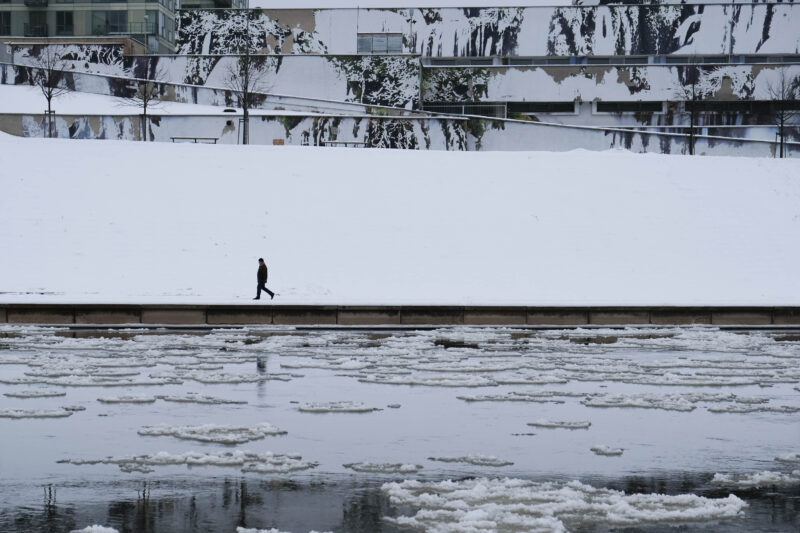
Sitting in a cosy cafe on Užupio street, I look out the window between sips of coffee, marvelling at the flurry of heavy snow that is beginning to cover the country’s main thoroughfare like a thick, white quilt. A few people trudge by, shivering with their hats pulled down to their eyebrows and collars of their jackets zipped over their chins, leaving just a small gap for them to see. I take a bite of tinginys and peruse the A5 copy of Užupis’ constitution that I have in front of me. Suddenly I’m feeling very glad for the second bullet point on the list; “Everyone has the right to hot water, heating in winter, and a tiled roof”.
While that point seems perfectly valid, a few of the constitution’s 38 other points are a little quirkier. Points twelve and thirteen read “A dog has the right to be a dog” and “A cat is not obliged to love its owner, but must help in time of need” respectively. The letterhead of the document is a graphic of the republic’s flag, what is known as the ‘Holy Hand’: a blue hand with a hole in the middle, making it unable to accept bribes. At the bottom is one sentence: “DO NOT FIGHT. DO NOT WIN. DO NOT SURRENDER”
Looking back at the window to assess the snow situation, I watch as a dog trots towards the main square, cocks its leg against a signpost, then gleefully continues on its journey. Just a citizen of the Republic of Uzupis exercising his constitutional rights.


Eastern Europe is no stranger to breakaway states – Srpska, Transnistria, and Kosovo just to name a few – but Užupis is certainly the quirkiest. Located within Vilnius, just across the Vilnia river and metres away from the ornate churches and alleyways of the Lithuanian capital’s charming, medieval old town, Užupis is one of the smallest republics in the world, covering less than 1 sq km.
Sitting in a bend of the narrow Vilnia River, Užupis (literally meaning ‘beyond the river’) was originally home to mill workers and craftspeople. The neighbourhood has always been occupied by people with modest means but, under Soviet rule in the 20th century, it quickly fell into dereliction. It was an undesirable place to be, filled with crime, crumbling industrial decay, and brothels. Užupis Street was even nicknamed ‘the Street of Death’, due to both its high crime rate and in recognition of the neighbourhood’s Jewish population, which was decimated during the Holocaust. Most of Vilnius’ residents avoided the area altogether.
However, following the collapse of the Soviet Union, things began to change. Once Lithuania gained its independence in 1990, artists who had been stifled under the Soviets moved in, making the most of the Užupis’ cheap rents. They began building a community of progressive, free-thinking people – an artistic utopia. 7 years later, on the 1st April 1997, the residents of Užupis decided to declare their independence.
Crossing the small bridge into Užupis earlier that day, there wasn’t much indication that I was heading into a new country: No walls, border crossing, or guards, just a sign reading ‘Užupio Res Publika’ adorned with an image of a smiling face and a picture of the Mona Lisa. Unlike Europe’s other breakaway states, Užupis independence is a little tongue in cheek. First of all, it isn’t officially recognised by any of the world’s other nations, although it is tolerated by the Lithuanian government. From what I can tell, it is part parody, part elaborate performance art that has managed to continue non-stop for over 20 years.

Despite declaring themselves a micro-nation on April fools day, the residents appear to be very committed to the joke. They have a president, cabinet of ministers, an anthem has been composed and a constitution authored. They have their own currency, flag, and even mobilized an army (of just 12 members) which has since been disbanded. Their Independence Day takes place on – of course – April 1st and on this day, you must take part in the performance and get your passport stamped as you cross the bridge into the republic (every other day, the border is not guarded), the local currency is used, and beer flows freely from the fountain in the main square. Užupis also has its own ambassador, who just happens to be a portly, ginger tabby cat that spends most of his time sleeping in the neighbourhood’s book shop. I didn’t spot him during my visit, so I can only assume that he was out on diplomatic business.
While its military may not be considered formidable, and its existence considered a bit of a joke, the ideas behind Uzupis are still taken as seriously as ever by its residents. Its creation was always a reaction to the tyranny that the Soviets thrust on Lithuania. The founders wanted to create a place of inclusion, where freedom of expression is embraced and where people have the right to be who they want to be. That commitment is most clear in the Republic’s constitution.

Drafted by founders Romas Lileikis, a poet and film-maker, and Tomas Čepaitis, a librettist, the constitution is displayed on several mirrored plaques adorning a faded yellow wall on Paupio gatvė, known locally as the Avenue of Constitutions. Originally displayed in both Lithuanian and English, there are now 30 plaques in different languages, spelling out its 38 points in everything from Latin and Yiddish to Hebrew and Urdu. It encapsulates the essence of Užupis’ ideals of free thought, with points such as ‘Everyone has the right to be unique’, ‘Everyone has the right to be happy’, and ‘Everyone has the right to understand’, as well as, confusingly, ‘Everyone has the right to understand nothing’.
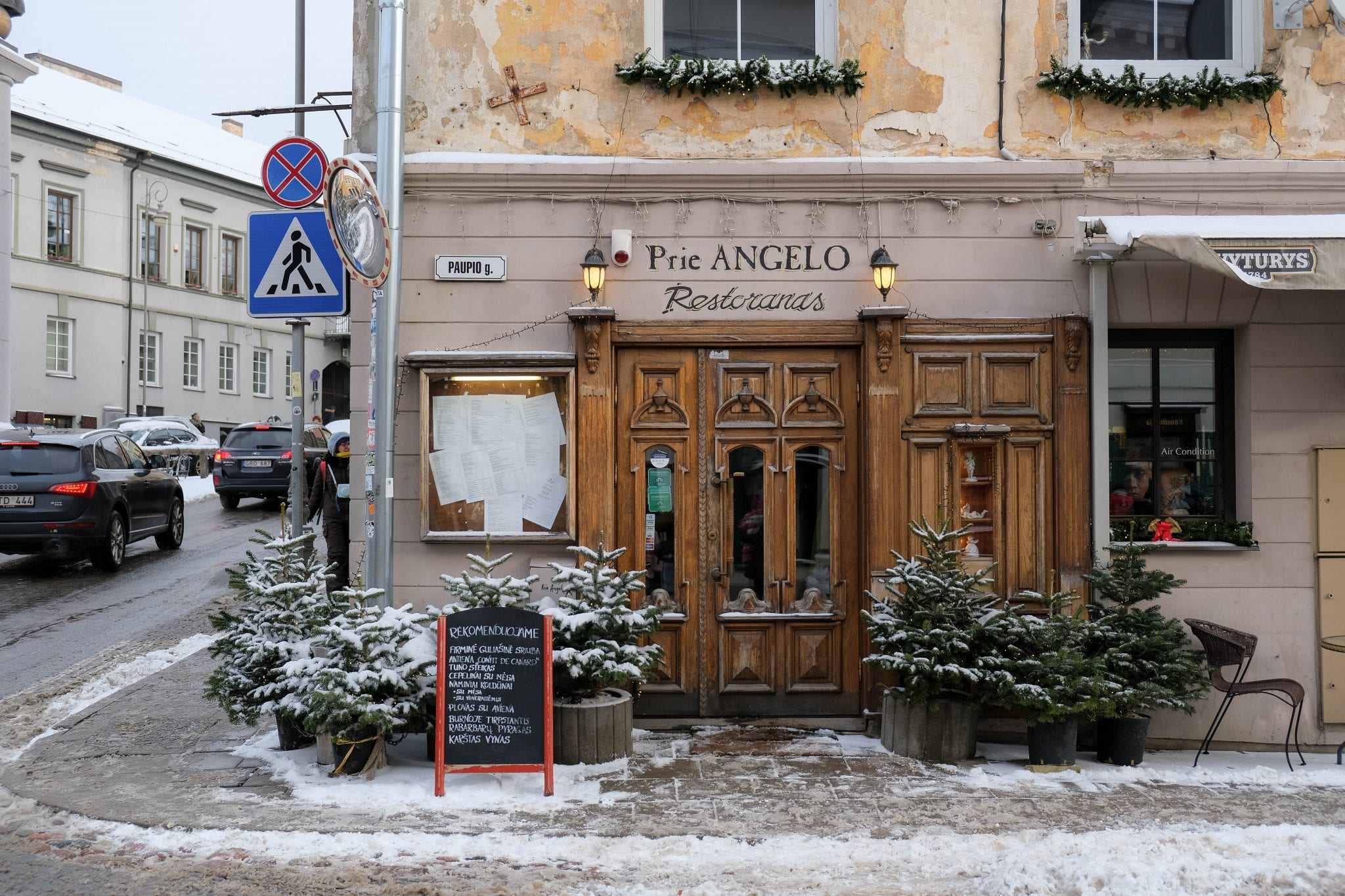
I contemplate the etchings for a while before heading into Keistoteka, the quaint bookstore opposite, to purchase my own printed copy. By now, lunchtime is approaching and the sky is clouding over in a deep, charcoal grey. The saffron buildings and their olive-coloured shutters of this bohemian enclave cast in shadow and battered by snow. From the doorway, I watch locals and visitors alike, strolling past in the freezing conditions, pausing to read the constitution, the gleaming plaques reflecting the readers and the crumbling sienna and terracotta of the tall houses opposite.

The end of Paupio gatvė opens out onto the Republic’s main square, where a statue of a trumpeting angel stands high above the neighbourhood atop a pillar. Unveiled on Užupis’ Independence Day in 2002, the angel has become the symbol of the republic, a symbol of growth and rebirth, his trumpet heralding a new free-thinking age for the nation.
Now home to around 7,000 people (with around 1000 artists among the population), much of the degradation and atrophy caused by Soviet neglect has been reversed. Užupis has piqued tourists’ interest since its inception in 1997 and the unintended consequence is that the republic has experienced its fair share of gentrification, prompting a spike in property prices. It is currently the second most expensive place to live in Vilnius, after the Old Town. The artists and type of people that created Uzupis’ in the beginning would no longer be able to afford to live there.

This has caused concern for some local residents and government officials, who fear the loss of their culture and way of life as tourist numbers grow and the population swells. However, they have hope that the Republic’s popularity shows that there is a desire for countries such as Uzupis to exist.
Although it is seen by many as just a quirky visitor attraction in recent years, its roots as a hub for creativity remains. Artworks have been installed along the bank of the river, in the small parks, and hanging from the sides of the small streets. A wander down any of the alleyways and courtyards filled with studios and workshops reveals street art and curiosities at every turn, from murals adorning buildings to windows decorated with tiles portraying ginning faces. Outside the post office and countries gift shop – a place where you can pop in to unofficially get your passport stamped – you will find semi-naked stone busts and a giant cartoon mallard holding up a ‘welcome’ sign. Beside the church is a stylised statue of a backpacking Jesus. A short walk from there is an alley completely covered in street art and temporary pieces of sculpture.

As for me, I take a short walk around this tiny Republic, examining as much art as possible and exercising my own clearly documented rights to idleness and anonymity. But perhaps, most importantly, I can’t help feeling a connection to item number 16, “Everyone has the right to be happy.”
Where to Eat & Drink in Užupis
Sweet Root
Užupis is home to one of the most highly rated restaurants in all of Vilnius, Sweet Root, offering local root vegetables served in inventive ways with meat and fish. The dishes are small to allow you to try a few different ones and they offer a creative seven-course tasting menu.
Where: Užupio g. 22, Vilnius
Opening times: Weds to Sun 6pm – 11pm.
Coffee 1
Coffee 1 is a great independent cafe to match the independent spirit of Užupis. Although it was once situated in narrow, nondescript premises on Užupio Street, it has since moved across the road to a much larger, modern venue with both upstairs and downstairs seating. Although the coffee isn’t necessarily the best you’ll find in the city, the staff are incredibly friendly and they offer a great range of tasty treats such as cookies and traditional tinginys, which translates as “lazy cake,” because it’s an easy-to-make combination of chocolate, sugar, and biscuits.
Where: Užupio g. 9, Vilnius.
Opening times: Mon to Fri 7.30am – 8pm; Sat 8am – 8pm; Sun 9am – 7pm.

Špunka
This small bar Užupio street only has a couple of tables but offers a great view out onto the main square and the Angel of Užupis statue. They offer a wide selection of locally brewed beers and you never know, you may even bump into Užupis’ President, Romas Lileikis.
Where: Užupio g. 9-1, Vilnius.
Opening times: Tues to Sun 3pm – 11pm; Mon 5pm – 11pm