
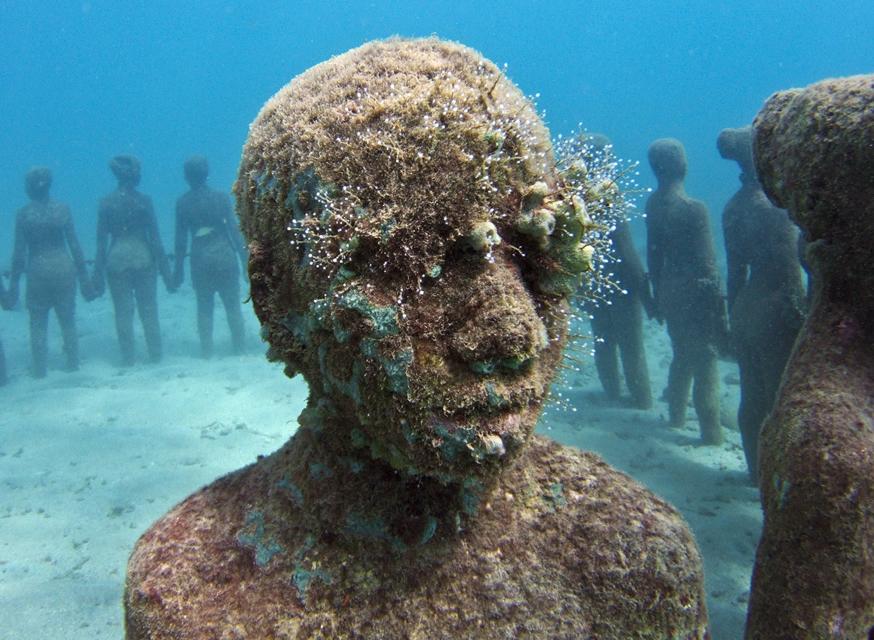
Through the hazy water, I can just about begin to make them out; a ring of ethereal figures, children mostly, standing to attention, hand in hand. Moving closer, their outlines solidify and I can make out their faces, features worn from years spent underwater and their concrete skin pock-marked with coral.
Sponges cross their cheeks like colourful veins. Tunicates burst from their faces and colourful fans oscillate at their feet. despite my presence, groups of parrotfish, flounders, and bright yellow angelfish explore the stone figures.

Molinere bay is currently home to over 70 such sculptures, the first of which were sunk to the Grenadian sea bed by sculptor and environmentalist Jason Decaires Taylor in 2006. In doing so, Jason created the world’s first underwater sculpture park.
Taylor, born to an English father and Guyanese mother, creates his works from concrete and rebar and bolts them to the sea bed. It may seem like a strange place to display his work, but Jason’s aim isn’t to just provide a series of beautiful marine seascapes for snorkellers and scuba divers, he wants to create a series of artificial reefs, drawing new life into areas that have been damaged by both humans and the power of nature. The pH-neutral cement provides a stable and permanent platform for life to grow, and it is textured to allow coral polyps to attach. The sculptures are all positioned down-current from natural reefs to give new coral a place to settle after spawning.
That’s why Taylor’s first sculpture in the shallow waters off Grenada, Grace Reef, was built in a bay where the coral growth and natural habitat had been decimated by Hurricane Ivan. It comprises 16 statues, each cast from the body of a local Grenadian woman and positioned lying down on the seafloor. Within a year, the statues were already inhabited by new life.
Over time, more and more statues have been added. Some of the more notable ones are ‘The Lost Correspondent’, a man working at his desk and typewriter; ‘Unstill Life’, a classical still life composition of a vase and bowl of fruit on a table, and Jason’s most famous work in Grenada, ‘Vicissitudes’, a circle of life-size figures holding hands, cast from local children. With Vicissitudes, in particular, Jason has used his work to help local children to build a direct relationship with, and understanding of, their own precious natural resources.


Adding attractions beneath the water gives people something to treasure. Grenada’s sculpture park is not only a tourist pleaser, but it is also now a designated National Marine Park that aids conservation efforts. Entrance fees fund park officials to properly manage the reef, fishing quotas, and tourism.
Unfortunately, since its installation, Grace Reef has been torn apart by another hurricane. However, destruction and change is very much part of the sculpture park. As the sculptures interact with their underwater environment in unpredictable ways, the art becomes more interesting and more complex. Sponges and algae layer upon the concrete and plants begin to grow from cracks and crevices. The pieces don’t erode and wear away, instead, they grow. They are transformed from inanimate objects to something that is full of life.

Such has been the success of Molinere’s sculpture park, Taylor has gone on to create similar projects in other parts of the world, like Museo Atlantico off the coast of Lanzarote, Museo Subacuático de Arte in Cancun, and Nest in Indonesia. The Grenada Tourism Authority has even begun to add additional works beyond Jason Decaires Taylor’s initial 65, such as Christ of the Deep, created by Troy Lewis, to commemorate the 50th anniversary of the sinking of the Bianca C, and the Nutmeg Princess by artist Lene Kilde, inspired by the 1992 book The Nutmeg Princess, depicting a princess emerging from a large nutmeg pod, reaching for the surface with a handful of Grenada’s most prized spice.

Information
The park covers 800sq metres of Moilinere Bay, located two miles north of the capital St Georges. It is fairly close to the shore and can be reached by land, by walking down to Dragon bay, following the beach southwards and then swimming out to sea. Although some of the sculptures are close to the surface at just 6ft down, others can be as low as 8 metres and harder to find. As such, it’s recommended that you visit on an organised boat trip, as a guide will take you around the park, pointing out all of the statues.

To get the best experience of the sculpture park, I would highly recommend scuba diving. ScubaTech offer single and 10-dive packages as well as trips to explore some of the shipwrecks dotted around Grenada’s coast.
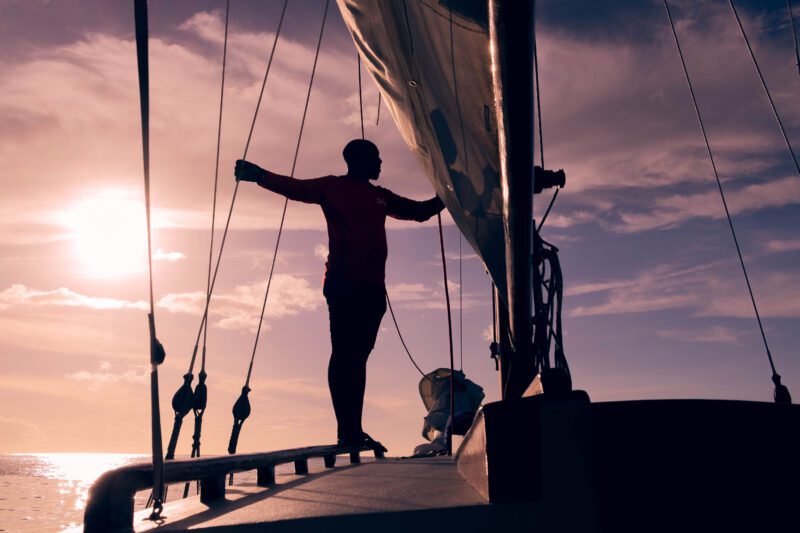
If scuba isn’t your thing, or you haven’t passed your open water training, Savvy Sailing offer a half-day and full-day snorkelling cruises taking in Molinare Underwater Sculpture Park as well as Dragon Bay and Flamingo Bay. The full-day cruise includes lunch on board the sloop.
Those wanting to visit the Grenada Underwater Sculpture Park can purchase a day pass from the Ministry of Fisheries at a cost of US$1 for snorkellers or US$2 for divers. All proceeds go towards the upkeep of the park and the protected marine area. If you organise your dive through an agency or local dive shop, your fees will typically be included in the price.

Where to Stay in Grenada
True Blue Bay Resort
Built near to a yacht-filled harbour in the island’s south-west corner on what was a former Indigo plantation, True Blue Bay Resort is certainly one of Grenada’s most fun and funky hotels. Colourful beach huts and luxurious apartments line their waterfront beach-style pool area. The hotel also offers two more swimming pools, a marina, dive centre, spa and a gym.
The laid-back Dodgy Dock, looking out over the marina, is one of the hotel’s main selling points and is a popular drinking and dining spot with local, and tourists alike. Their weekly Street Food event is something that everyone visiting Grenada should experience. Plus, the hotel’s staff are some of the friendliest and most helpful I have experienced in any hotel.
An added bonus is the hotel’s green credentials. Plastic use is kept to a minimum, solar water heaters are used in all rooms and restaurant kitchens, no chlorine is used on the property and all cleaning products used are eco-friendly.
Book it here.
Laluna Resort
Laluna, with its hip, pared-down Balinese design and laid-back character, is one of the best, luxury boutique hotels on the island. Set above a beautiful, 300-yard-long soft sandy beach lined with swaying palms, the property offers small and quirky bungalows as well as stunning, stylish apartments complete with their own infinity pools.
Book it here.
Petite Anse Hotel
While many of Grenada’s resorts are concentrated around St. Georges and the south side of the island, Petite Anse Hotel is one of the few situated in the north of Grenada, and as such, feels nice and isolated as well as being perfectly placed for exploring this little-visited part of the island. Run by Phillip and Annie Clift, the British owners who built Petite Anse from scratch, the property sits on a hillside above the wild and secluded Petite Anse Beach with the restaurant/bar giving enchanting views of the sea.
Book it here.
Practicalities
Getting to Grenada
Virgin Atlantic offer flights to Grenada from London Gatwick via St. Lucia. Flight time is around 9 and a half hours.
Currency
The official currency on Grenada is the Eastern Caribbean dollar (EC$) which is exchanges at around EC$2.70 to 1 US dollar at the time of writing. Shops, bars, and restaurants accept both US dollars as well as EC dollars, though you’ll be given change in EC dollars. Most places quote prices in both currencies, however, cash points only issue EC dollars.
I visited Grenada as a guest of the Grenada Tourism Authority. However, all opinions are my own.

One Response
Wow Absolutely Stunning!