North Yorkshire has its fair share of myths and legends. Often these stories are restricted to tales of smugglers or seafaring heroism but occasionally they veer towards the ghoulish, ghostly, and supernatural. In the north of England, a Boggle – or Boggart – is one such entity. Some describe them as a form of hobgoblin that can be blamed for all manner of ills; soured milk and failing crops, while others see them as mischievous oiks that lurk under bridges waiting to spirit away unsuspecting travellers.
The Boggles of Runswick Bay are a little different. In these parts, local people used to believe that they had healing powers, and would sometimes bring their sick children to the series of holes and caves that are dug into the crumbling cliff faces, called “hob holes”, where Boggles were thought to live, in the hope that they would be cured. Getting their attention wasn’t always easy: worried parents would need to light a fire beside the cave and singing: “Hob Hole Hob, Hob Hole Hob, Me bairn’s getting t’kink cough, Take it off!” while carrying the sickly child in their arms.
It seems that the mysterious goblins are much more elusive these days, and the village of Runswick in which they live is not too dissimilar in its timidity. It’s not until you are virtually on top of the bay, at a point where the purple heather and emerald green grasses of the moors seemingly tumble down over the muddy cliffs scarred by millennia of landslides that you see the golden sands of Runswick Bay beach.

Contrary to the peaceful charm found in the picture-perfect cluster of whitewashed cottages and the flawlessly formed semi-circular bay that sits below the craggy cliff faces, this is a rough, rugged and dangerous stretch of coastline. The beach is windswept and weather-beaten and these bluffs that surround it often give way to gusts and currents, depositing their mineral-rich contents on the sand below. These deposits are what make Runswick Bay beach such fertile grounds for fossil hunters and archaeology enthusiasts. People often stumble upon dislodged ammonites and Jurassic marine fossils amongst the usual lumps of jet that are scattered across Kettleness Sands.
It’s this beach that is Runswick’s main draw. In the summer months, hundreds of people schlep down the slope from the Cliffemount Hotel in the upper village and make their way down to the sand. It stretches a mile and a half east to Kettleness Headland – curiously also known as Randy Bell End, much to my delight – where the expansive shoreline is used to its full advantage by visitors; Swimming, sports, and sandcastle building are the order of the day.

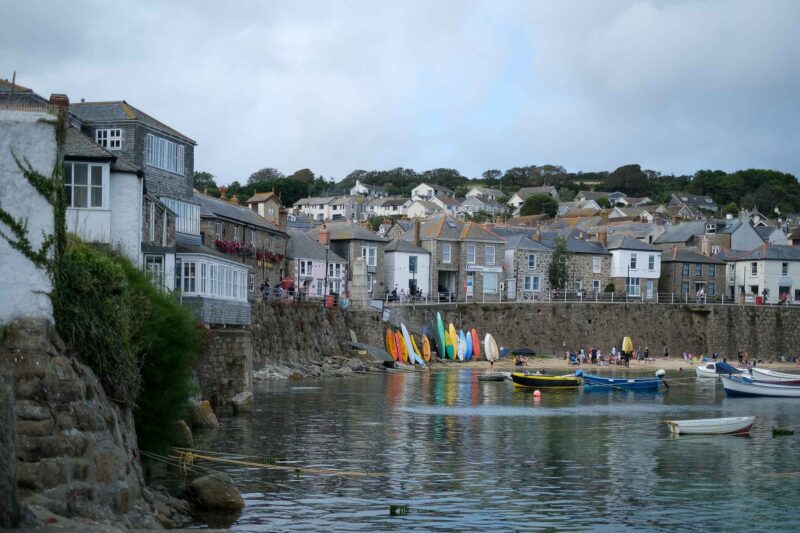
If the beach seems so wide, it’s because the old, lower village of Runswick takes up just a tiny proportion of the bay. It is as if the sand, in the process of unfurling itself along the seafront, pushed all the buildings aside so that they folded and bunched up in a corner beside the cliff edge, piled on top of each other in no real order.


As pristine as this quaint, chocolate box hamlet looks now, it has a perilous past. in 1682, the soft Jurassic shales gave way in a landslip and swept away the entire village. Runswick had to be rebuilt. Thankfully, no villagers were injured in the incident. They were all at the wake of a recently deceased neighbour. Legend has it that the dead man’s house was the only one left standing. The currents in the surrounding seas can be just as dangerous; In 1901, all the village’s able-bodied men (including the lifeboatmen) were caught in a storm while fishing out at sea. On this occasion, Runswick’s women launched the lifeboat and came to their rescue. The lifeboat station still stands at the top of the bays slipway, although it was only in use until 1970.

Beyond the slipway, you can weave past the tiny café and the lone village pub, wind through the narrow lanes of the rebuilt Runswick – now mostly given over to holiday renters instead of being occupied by the fisherman that once landed their catch here – towards the centuries-old thatched coastguard’s cottage that juts outward towards the waves. From this vantage point, you can take in the entire sweep of the bay, its hob holes and golden sand, with the lilac-speckled moors that extend beyond, inland to the heart of North Yorkshire. From here, It’s hard not to fall for the charm of Runswick Bay.
Where to Stay in Runswick Bay
OYO Cliffemount Hotel
As its name suggests, you will find The Cliffemount Hotel in the upper village where it has a spectacular vantage point overlooking old Runswick Bay Village. This is the only AA Star-rated hotel in Runswick bay and the rooms are suitably comfortable. There is also a restaurant with fantastic coastal views.
The Firs Guest House
This family-run guesthouse in the upper village is a little further from the sea but still only a 10-minute walk. While most of the rooms are a little old-fashioned, they do have a quaint country style. A free full English is included and there is amble off-street parking at the property.
The Runswick Bay Hotel
Situated in the upper village on Hinderwell Lane, you will find the Runswick Bay Hotel, perfectly located just a 5-minute walk from the beach (albeit down a steep hill). They have six rooms available, all with en-suites and a popular and cosy on-site bar. Breakfast and parking are included with each room.
Where to Eat & Drink in Runswick Bay
Due to the small size of the village, visitors to Runswick Bay shouldn’t expect any high-end dining or culinary surprises. However, as with most of Yorkshire’s seaside hotspots, you will always stumble across a pub serving up decent pub food and a spot or two to grab a cuppa.
Sandside Café
Located just beside the slipway and lifeboat station, The Sandside Café is a simple, traditional beachfront diner with an outdoor terrace overlooking the sea. The manu is fairly basic, consisting of the usual hot and cold drinks, cakes, and sandwiches (give the crab sandwich a go if it is available).

The Royal Hotel
The only pub to be found in the lower portion of the village, the Royal Hotel has a decent selection of real ale (Black Sheep is normally on cask alongside some guest beers) and offer up the usual pub food fare for both lunch and dinner. The pub is dog-friendly and and has an outdoor terace with lovely views over the bay.
Runswick Bay Tea Gardens
The only real ‘hidden gem’ in Runswick Bay, the Tea Garden is closed for the majority of the year but pops up around high season when the crowds descend on this stretch of the Yorkshire Coast. Here you will find tea, coffee, delicious cakes and scones all made by the friendly local owner, Anne.
Getting to Runswick Bay
Runswick Bay is located just 8 miles north of the bustling coastal town of Whitby and 11 miles southeast of Saltburn-By-The-Sea but is unfortunately much more difficult to reach than either of these two seaside hotspots when travelling by public transport.
The popular Coastliner bus route that travels from Leeds – then through York and Malton – before reaching the Yorkshire coast terminates at either Whitby or Scarborough so you will have to change buses at either of these points. From Scarborough you will need to take the X93 or X94 up to Whitby and then from Whitby, the X4 Sapphire service will take you to Runswick.
If travellng from the North, you can also catch the southbound X4 Sapphire service, however, the route begins in Middlesborough so you will need to reach Teesside first.

Parking at Runswick Bay
Visitor numbers at Runswick bay are somewhat limited by the measly number of spaces in the at the bottom of the steep, beach-bound road. However, you will find much more paring spots in the pay-and-display carpark at the far end of Banktop Lane, just opposite the Cliffemount hotel. However, this can become fairly full during the summer.