
“This is the last, dying breath of Shoreditch’s street art scene”
Gregory points from side to side and I follow his gaze, expecting to see some small indication of graffiti’s demise daubed on the walls around us. We’re stood in a non-descript yard just off brick lane, halfway between Fashion Street and Fournier Street. Directly in front of us are two portraits of women covering the metal door of a garage and the adjoining wall, one by Nottingham based artist Dreph and another by London’s own Carleen De Sozer. This little alleyway is a treasure trove of street art, every wall bursting with colour and works by some of the country’s most well-renowned artists such as Fanakapan, ThisOne and Mr Cenz.
However, what once acted as a sort of open gallery for artists, a spot for them to paint and repaint an ever-changing exhibition, has recently been acquired by a local business to use as a car park, making it much harder for artists to gain access to the walls. Even today, some of the pieces are blocked from view by vehicles.
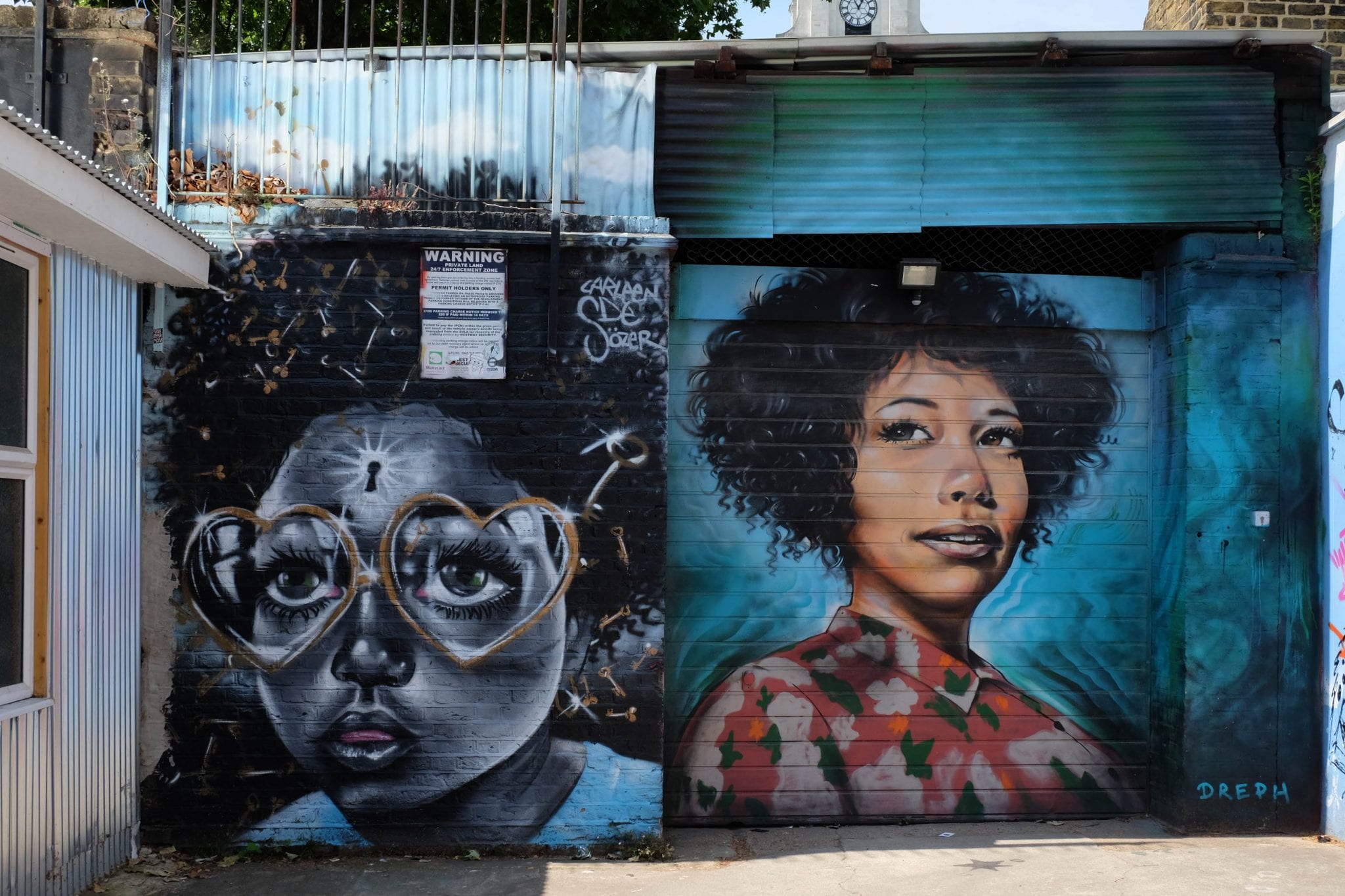
Gregory is taking me on a street art tour of Shoreditch, known by some as the World’s greatest outdoor art gallery and seen by many as the epicentre of London’s street art scene. Although Gregory’s closing words put that in doubt. To him, the street art scene around Brick Lane is almost done, with many artists choosing to work south of the river in places like Clapham and Brixton.
That isn’t to say that there Brick Lane is devoid of great work. Some of London’s best and most famous pieces can be found on the walls around Brick Lane, making it the perfect spot to indulge in a little history of the city’s street art scene. Gregory is an artist himself, both incredibly passionate and knowledgeable about the subject. He assures us that during the two-hour tour, we will see a fair bit of his work but he won’t tell us his street name or even which paintings are his. After all, graffiti is still very much illegal in the UK.


That makes our starting point even more unusual: Outside of Brick Lane Police Station opposite Chicksand Street. Gregory points us towards a large, fluorescent yellow mushroom standing atop a nearby building. This and dozens of other similar sculptures have been placed around the city by Christian Nagel. It’s his way of showing that the influence of street art is unstoppable, spreading throughout the city like a fungus. Christian manages to dot them around the city while avoiding the authorities by dressing in a hard hat and hi-vis vest and renting scissor lifts. Blending into his surroundings while doing something totally illegal.
Other forms of graffiti are less well hidden. Gregory tells us to look towards the wall of the Sticky Ribs on Chicksand Street. There’s a beautiful bold mural painted in bright blues, yellows and pinks. Our group lets out a few ‘ooohs’ of delight before chastising us.

“Who’s looking at the mural?” The whole group raise their hands. “What you should be looking at are the tags on the red shutter next to it.” Our eyes collectively shift left to the crowded collection of scrawled words and phrases. It’s much less pleasing to the eye and it is easy to see why most of us looked straight past it. However, Gregory explains just how important tagging is to the street art scene. While most people see it as brainless vandalism, he sees is as graffiti in it’s purest form.
“The difference is that graffiti is letter-based, it’s character-based and usually done with spray paint. Many people see it as vandalism. Street art, on the other hand, is something that people want to see. They want to look at images and portraits. These can be done with stencilling, can be painted with brushes, they can be posters and paste-ups”

It’s clear that Gregory has a bias towards traditional graffiti rather than the huge murals that many people visit Shoreditch to see. We avoid seeing some of the more famous works; the Banksy’s, the ROA’s, and the Conor Harrington’s. Instead, we plodded our way along the backstreets looking for tags and some of the area’s hidden gems. Even when we came across some work by Sheffield artist Phlegm, one of the countries most well-known and well-respected street artists, Gregory took more time explaining the tags on an adjacent wall than Phlegm’s monochrome masterpiece.

After a brief explanation, I finally see why he holds tagging in such high regard. What to us may just be random scrawls are in fact a calling card for the city’s many graffiti artists, a way for them to hone their skills and get their name out there. Most of the big-name artists that are now commissioned to paint huge murals on the sides of buildings all over London started out with tagging. They would often set out at night, scrawling their calling card up to 40 or 50 times a night around the city as a way to be seen and gain respect.
So when is tagging seen as art, and when is it vandalism? To Gregory, tagging has a style and finesse to it. He points out 3 orange letters scrawled over the top of Phlegm’s piece spelling out “BLM” or ‘Brick Lane Massif’. “There’s no style to this and the way it is scrawled across the other work is disrespectful. It’s not the work of an artist, but of a local gang. They don’t care for the street artists, and deface their stuff whenever possible.”

The point is brought home when we spot an artist painting a new mural on the railway bridge beside Allen Gardens and Spitalfields City Farm. “It’ll be there for 3 days before it’s painted over if she’s lucky. It’ll probably be gone by tomorrow.” Explains Gregory.
This just shows the transient nature of street art. It’s not supposed to be permanent. We find ourselves in a small courtyard hidden between a dozen or so terraced houses. On the far wall is one of the most beautiful murals I see on the whole of our tour; An abstract portrait of a woman in swirls of blue and orange. It’s by Mr Cenz. Gregory informs us that in a little less than a week, the mural will be gone, paint over by another artist for a show at the Whitechapel Gallery. Just like any exhibition at a traditional art gallery, the pieces change. With street art, they fade or are painted over.

Maybe that is why London’s street art scene has made its home around Brick Lane. As a neighbourhood, it is also constantly undergoing radical changes. From as early as the 15th century, this part of Shoreditch was home to the brewing industry. Then came the French Huguenots in the 18th century, making Brick Lane a centre for weaving, tailoring and the developing clothing industry. This resulted in an influx of Irish and Ashkenazi Jews immigrating to the area, cementing Brick Lane’s reputation as the multicultural heart of London. The street is now mostly known as an important hub for the Bengali community. A little nod to this can be seen in Jim Vision’s incredible ‘Paradise Lost, in the Midst of Things’ on the side of Banglatown Cash & Carry in Hanbury Street.

In more recent years, Brick Lane has become a centre for London’s art and fashion scenes. Although the epicentre for what is considered cool in London keeps changing, Brick Lane and Shoreditch seem to be a permanent fixture despite growing gentrification. The street art of the area has played a big part in this and has become much more accepted by the mainstream as a result. Many people visit East London for street art alone.
This acceptance has allowed artists more freedom than they have ever experienced before. Gregory explains that the railway bridge alongside Allen Gardens has been a bone of contention for a while. Whenever the walls here are painted, the art is quickly removed. However, recently TFL has allowed the artists to turn the bridge into a permanent gallery, finally accepting that street art can be beautiful rather than seeing it as a mere act of vandalism.

Artists have also been allowed to create a permanent art space, known as the Nomadic Community Garden, on derelict land next to the railway tracks. It’s a rabbit warren of temporary structures; wooden huts that house cafes, bars and workshops. Everywhere you look there’s a riot of colour and paint as artists have free reign to express their creativity on this little patch of land. As we wander around on a Saturday morning the garden is fairly empty other than a group of young children, aged around 7 or 8 and splashed with a rainbow of paint, having an art class with a local graffiti artist. A space like this just shows how far we have come from the days when all graffiti was seen as vandalism.


However, street art’s acceptance into the mainstream isn’t without its issues, even within the art community itself. While it is now easier than ever for artists to find walls to paint – often businesses and landlords offer up the side of their buildings to artists – many see it as being commercialised with people being paid large sums of money to create murals advertising international brands. During my short walk around Shoreditch earlier that morning I had seen two walls painted in a street art style, but advertising both a popular bank and an expensive watch brand. A mural on Code Street by Nomad Clan – Cbloxx and AYLO, aka Joy Gilleard and Hayley Garner – shows a woman with her eyes crosses out, holding handfuls of burning money – a commentary on street art selling out. Maybe that’s what Gregory means when he says that the Shoreditch street art scene is dying.
We finish the tour at the Old Truman Brewery, once the industrial centre of the area, but now a space occupied with bars, cafes and shops. It is the best place to see work by some of the world’s most famous artists; there are works by Space Invader, Shepard Fairy and even a classic car in hot pink that was placed there by Banksy. Gregory half-sneers at the way the Banksy car is now hidden behind plexiglass for protection, explaining once again that street art isn’t meant to be protected, isn’t meant to be permanent. I’m beginning to see the reasoning behind his original statement.

The next day, I spend the morning wandering around Brick Lane Market. With the roads closed, food stalls fill every available space, pumping plumes of delicious smells into the air. Tarpaulin-covered tables are laid out with antiques and tat on display for all to see. Once you pass the Old Truman Brewery, the party atmosphere begins, with musicians tapping away to tinny Reggae, open grills throwing out clouds of smoke and vendors yelling out to passers-by, trying to gain their custom. For me, this is when the area really comes alive and shows how vibrant it is.


As I cross the railway bridge beyond Pedley Street, I see them: Half a dozen street artists, 3 on each side of the road, scrawling fresh graffiti on the metal sidings. They aren’t painting a mural or an advertisement, but intricate tags of their names. A few streets further, I see a middle-aged man on a scissor lift. He’s holding a piece of paper with a photograph on it. He squints at the page, then at the wall before putting his brush to the brickwork and doing his best to reproduce it on a 30ft high surface. It’s only then that I realise I’m watching Dale Grimshaw, one of the countries most renowned street artists, painting his newest mural. Gregory may say that street art in Shoreditch is dead, but within half an hour of walking, I see almost a dozen artists, including some of London’s most famous, at work. It seems to me that the street art scene is still very much alive.


Where to Stay Near Brick Lane
During my time in London, I stayed at Wombats CITY HOSTEL. Located just a 10-minute walk from Brick Lane, it is the perfect base for exploring the street art of Shoreditch and the surrounding area.
Winner of ‘Best Hostel in London’ and ‘Best Hostel Chain’ at the annual HostelWorld Hoscar awards, Wombat’s is the perfect choice for anyone that is looking for stylish, central, yet budget accommodation. They offer both private and dorm bedrooms with en-suite bathrooms.
This post was brought to you as a result of the #wombatsTraveller blog trip, created and managed by iambassador in partnership with Wombat’s CITY HOSTELS. However, all views expressed are my own.

3 Responses
Absolutely fascinating – believe it or not, I am a Londoner born and bred and yet have only recently become fully aware of historic Brick Lane. My brother lives on one of the streets off the Brick Lane and for years I have ogled the artwork, intrigued by the morphing landscape of the area. I know nothing of art, but my senses as a human being marvel at the handiwork of Bricks Lane’s living creativity. Would it be possible to talk to you, perhaps interview you in connection with some educational research that I have embarked on? It is for an anthropological MA. Thank you for an amazing blog, insightful and enlightening.
Hi Dave
Lovely blog!
I am teaching a module on multiculturalism to students at Hult (aldgate east) and have been thinking of taking the students out on a culture trip to the Bricklane neighbourhood and see life beyond pubs and restaurants.
They are all international students (±20yrs) so this can be a great opportunity for them to understand London’s pot of culture through street art in Bricklane.
Do let me know if you know anyone who would be interested in doing this.
Thanks.
Hi Satrupa! Thanks for the kind words. I took the London Graffiti and Street Art Tour which meets daily at Exmouth Coffee Shop right beside Aldgate East station (11 am on Fri, Sat & Sun and 2 pm on Sat, Sun, Mon, Tues & Thur). Although they didn’t go too deeply into Bricklane’s multicultural history, the tour guide was a graffiti artist himself so had fantastic insights into the street art scene of London. The tour is free, but it is recommended that you tip the guide at the end of the tour as this is how they earn a living from the tours. I’m sure they would be able to accommodate a large group of international students!