I can’t help but feel that Lithuania’s capital, Vilnius, doesn’t get the recognition that it deserves. While it is known for its historic charm, particularly the winding streets and magnificent baroque churches of the Old Town, it is also modernising at a lightning pace to catch up with other European cities.
For every centuries-old palace or castle, there are dozens of craft beer bars and hip cafes. For every gallery filled with oil paintings of Lithuanian royalty, there are multiple huge street art murals. It’s this mix of old and new that make Vilnius so beguiling. There is something for everyone; fascinating history, ancient castles, quirky bohemian republics, subversive street art, incredible cuisine, and views of the city that are to die for.
It’s this contrast that makes Vilnius the perfect Baltic city break. I recently spent 3 days in a snow-covered Vilnius and instantly fell for its charms. I could have easily stayed for a week but I still managed to fit plenty in. Here are my favourite things to do in Vilnius.
The Best Things to do in Vilnius
1. Get Lost in the Old Town
2. Explore the City’s Street Art
3. Visit the Quirky, Breakaway Republic of Uzupis
4. Try a Local Delicacy
5. Climb the Bell Tower in Cathedral Square
6. Gediminas Castle
7. Wander through the Gate of Dawn
8. See the City from Above
9. Sample the Local Beer
10. Museum of Genocide Victims
11. Get Cultured at the city’s Museums and Galleries
Get Lost in the Old Town
The heart of Vilnius’ old town is the perfect place to start your exploration of the city. An enchanting jumble of pastel-tinged baroque houses, colourful churches, hidden alleyways and cobbled lanes, this UNESCO listed site is one of the best-preserved historical city centres in Europe.
However, this area of the city isn’t just a stale museum piece. The mix of Jewish, Russian and Eastern European influences make it fascinating architecturally, and also give it a sophisticated, cosmopolitan vibe. I recommend spending an entire morning or afternoon walking through the jumble of tiny streets, exploring every delightful nook and cranny.


Start at the iconic Cathedral Square, before making your way towards Vilnius University. Founded in 1579, the university now has 23,000 students and contains Lithuania’s oldest library. From there, make your way down the picturesque Pilies Street lined with street musicians, cafes and cute gift shops towards the grand town hall and the Gates of Dawn.

Nearby you will find the Jewish Quarter, a particularly charming part of the old town made up of labyrinthine, cobbled alleyways where colourful flowers tumble from balconies and hidden courtyards are found through each archway. Despite being named the Jewish Quarter, the area doesn’t retain much of its cultural heritage. While the city was once known as the Jerusalem of the North due to its huge Jewish population, the area between the City Hall and Didzioji street was transformed into a Ghetto by the Nazis and liquidated between 1941 and 1943. Even the Synagogue was destroyed, this time by the Soviets following the war. For more information on Vilnius’ Jewish history, you can visit the Tolerance Centre (Naugarduko g. 10/2; entry €3), situated in a beautifully restored Jewish theatre, or the Holocaust Museum ( Pamėnkalnio g. 12; entry €3) which gives an unflinching and harrowing account of the horrors that Lithuanian Jews suffered.
Explore the City’s Street Art
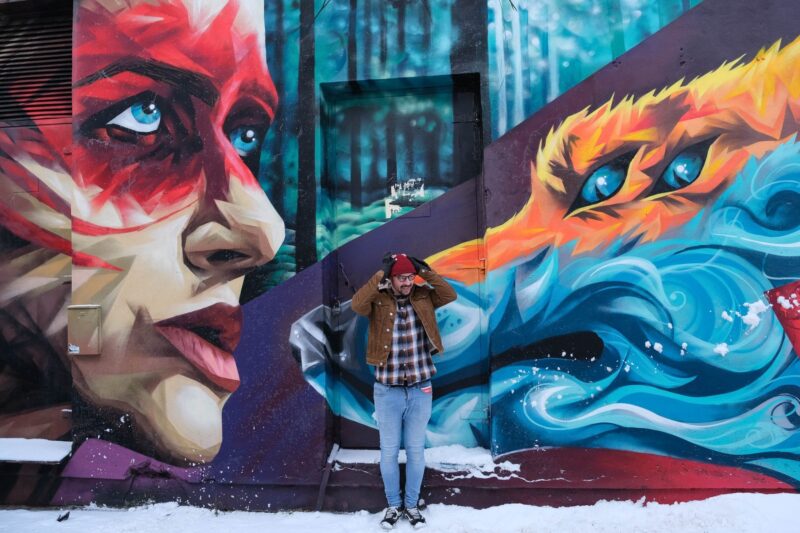
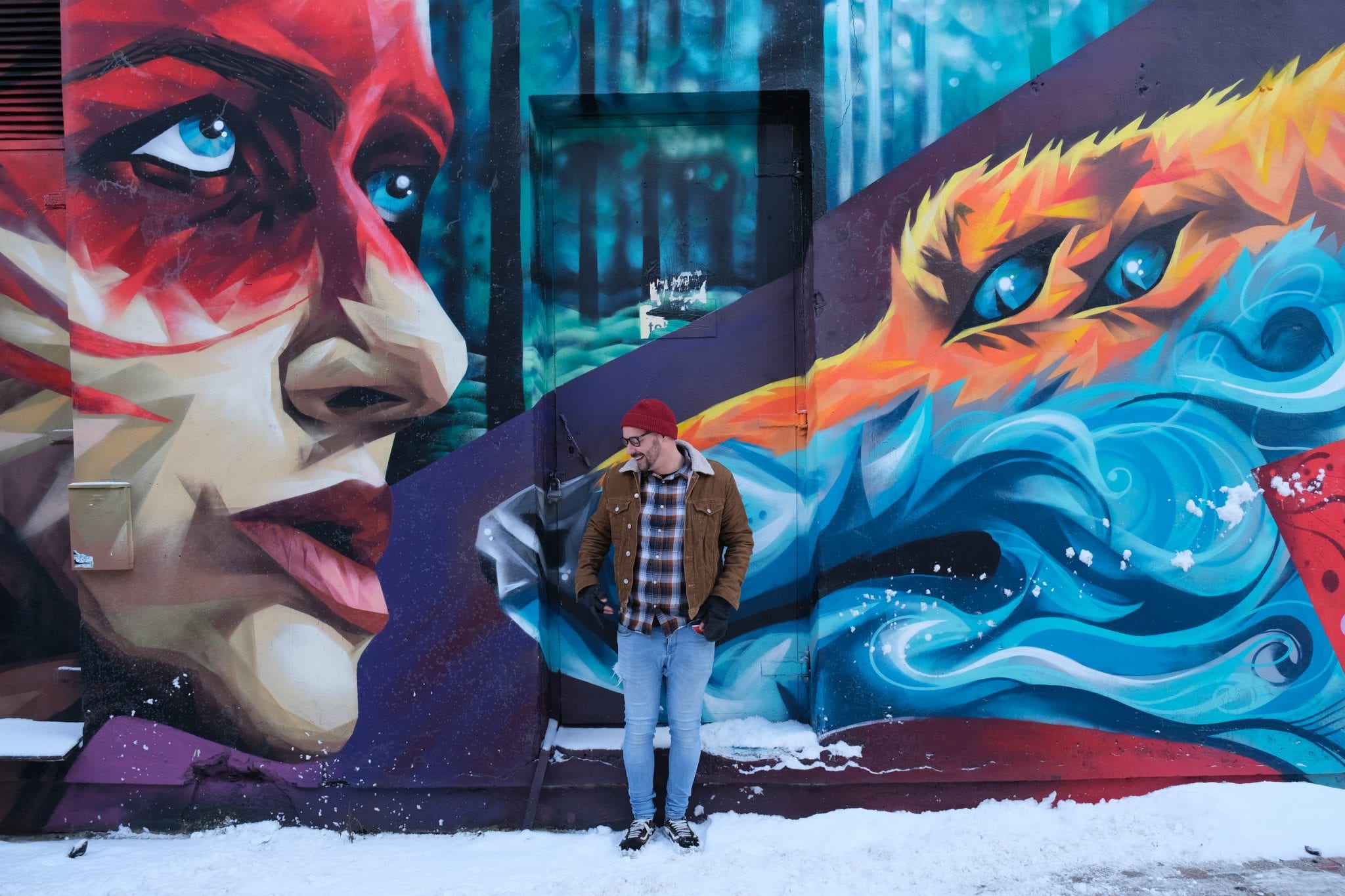
Vilnius may not look like the kind of city where you will find world-class street art. At first glance, the cobbled streets and pristine buildings of the old town seem far too immaculate to be defaced – or enhanced – by public artworks or spray paint, however, if you know where to look, you will see that the city is covered in pieces by world-renowned graffiti artists.

While a street corner mural of Trump and Putin locking lips is the city’s most famous public work, there are plenty of al-fresco pieces dotted around the city for you to discover, from a quirky Frank Zappa statue (erected by the Frank Zappa fan club to honour their prog-rock hero despite him never visiting Lithuania) to a street in the old town that contains a wall dotted with hundreds of tiny paintings.
The real stars though are the vast, facade-covering murals by artists such as M-City, Sepe & Chazme, Os Gemeos and Millo that play with the lines and geometric forms of the buildings on which they’re painted. The Vilnius Tourist Board has even published a map detailing the best street art in the city.
Visit the Quirky, Breakaway Republic of Uzupis
Eastern Europe is no stranger to breakaway states – Srpska, Transnistria, and Kosovo just to name a few – but Užupis is certainly the quirkiest. Located within Vilnius, just across the Vilnia river and metres away from the ornate churches and alleyways of the Lithuanian capital’s charming, medieval old town, Užupis is one of the smallest republics in the world, covering less than 1 sq km.
Sitting in a bend of the narrow Vilnia River, Užupis was an undesirable place to be at the end of the Soviet era, filled with crime, crumbling industrial decay, and brothels. Užupis Street was even nicknamed ‘the Street of Death’, due to both its high crime rate and in recognition of the neighbourhood’s Jewish population, which was decimated during the Holocaust. Most of Vilnius’ residents avoided the area altogether.


However, following the collapse of the Soviet Union, things began to change. Once Lithuania gained its independence in 1990, artists who had been stifled under the Soviets moved in, making the most of the Užupis’ cheap rents. They began building a community of progressive, free-thinking people – an artistic utopia. 7 years later, on the 1st April 1997, the residents of Užupis decided to declare their independence.
Unlike Europe’s other breakaway states, Užupis independence is a little tongue in cheek. First of all, it isn’t officially recognised by any of the world’s other nations, although it is tolerated by the Lithuanian government. From what I can tell, it is part parody, part elaborate performance art that has managed to continue non-stop for over 20 years.
Despite declaring themselves a micro-nation on April fools day, the residents appear to be very committed to the joke. They have a president, cabinet of ministers, an anthem has been composed and a constitution authored. They have their own currency, flag, and even mobilized an army (of just 12 members) which has since been disbanded. Their Independence Day takes place on – of course – April 1st and on this day, you must take part in the performance and get your passport stamped as you cross the bridge into the republic (every other day, the border is not guarded), the local currency is used, and beer flows freely from the fountain in the main square. Užupis also has its own ambassador, who just happens to be a portly, ginger tabby cat that spends most of his time sleeping in the neighbourhood’s book shop.

While its military may not be considered formidable, and its existence considered a bit of a joke, the ideas behind Uzupis are still taken as seriously as ever by its residents. Its creation was always a reaction to the tyranny that the Soviets thrust on Lithuania. The founders wanted to create a place of inclusion, where freedom of expression is embraced and where people have the right to be who they want to be. That commitment is most clear in the Republic’s constitution.
Try a Local Delicacy
Vilnius is a foodies dream, with the old town containing myriad wonderful cafes and restaurants. It even has a thriving vegan and vegetarian scene. However, if you’re looking for something uniquely local and Lithuanian, take a seat in one of the rustic old town taverns or pubs and try a local delicacy. Think a gluttonous pile of carbs, potatoes and meat, usually slathered in sour cream, or even more meat.
Almost every menu has cepelinai, zeppelin-shaped dumplings filled with meat that are then boiled or fried, and kibinai, which are traditional pasties. If that all sounds a little too heavy and meaty for you, there is always the saltibarsciai, a fluorescent pink beetroot soup that can be found almost everywhere.
Climb the Bell Tower in Cathedral Square
One of the most iconic sights in the city, Vilnius Cathedral and its neighbouring bell tower are worth a visit to see the beautiful architecture and interior decor of the building. Known fully as the Cathedral of St Stanislav and St Vladislav, the building sits in Cathedral Square, a spot originally used as a worshipping place for the Lithuanian Thunder God.
The real attraction though is the bell tower. One of the oldest and tallest towers of the Old Town, it’s a steep 52m climb to the top, but the panoramic views are well worth the effort.

Gediminas Castle
Perched on a hilltop high above the town, Gediminas Castle is visible throughout Vilnius. Well, what’s left of it anyway. Originally built in the 1400s, a tower and some of the walls are all that remain, but the castle offers a wonderful 360-degree view of the city and contains a fascinating museum documenting the history of the castle throughout the centuries.

Wander through the Gate of Dawn
As the only city gate of nine left from the historical wall that surrounded Vilnius over 600 years ago, the Gate of dawn has huge historical significance to the city, but it also has religious significance too. You will see people stop, lower their heads, and sometimes even cross themselves as they approach the gate for a quick prayer before passing through. This is because of the small chapel inside the Gate holding a religious icon which you can see shimmering from the street below.
Painted in the 1700s, the Madonna of Mercy icon draws pilgrims from all over the world and is unique as it features the Virgin Mary without baby Jesus. Whether you are religious or not, it is worth stopping by to see a piece of history.


See the City from Above
Imagine a sea of red-tile roofs only broken up by small squares, church spires, and patches of green parkland; that is what you can expect when getting a spectacular view of Vilnius from above. The city is certainly best viewed from a high vantage point. The best view can be seen from the Three Crosses Monument, situated on the gloomily-named Bleak Hill, particularly at sunset.
When I visited, the blizzard-like conditions meant that a climb up the hill certainly would be bleak, but never fear, there are plenty of other spots in the city to get a panoramic view. The sightlines from either Gediminas Castle or the Bastion are equally as striking. However, the campanile of St. Johns Church in Vilnius University is the highest point in the Old town.

When I visited, the blizzard-like conditions meant that a climb up the hill certainly would be bleak, but never fear, there are plenty of other spots in the city to get a panoramic view. The sightlines from either Gediminas Castle or the Bastion are equally as striking. However, the campanile of St. Johns Church in Vilnius University is the highest point in the Old town.
Sample the Local Beer
Apparently, beer in Vilnius is cheaper than in any other capital city in Europe. The city certainly isn’t short on pubs, with each street lined with a mix of upmarket bars, old-fashioned taverns and enough specialist beer pubs to keep beer lover’s busy for a long time.
Lithuania has a strong brewing tradition that goes back centuries, with every village seemingly having its own brewery. While traditional farmhouse ales and cheap, industrial lagers are the norm throughout the country, Vilnius has a burgeoning craft beer scene with over 20 bars in the city focussing on craft beer, or even having their own in-house microbrewery.

Šnekutis, Nisha, Bambalynė and the hilariously named Špunka should be your first port of call for a unique craft brew, but if you want something more traditional and uniquely Lithuanian, head to one of the many old fashioned pubs such as Alaus Namai, located just outside the old town beside the wide river Neris, or Būsi trečias.
Museum of Genocide Victims
This former headquarters of the KGB (as well as the Gestapo before them) houses a museum dedicated to some of the horrific events that played out in Lithuania during WWII and the latter half of the 20th century; people being murdered, imprisoned and deported.
While the contents of the exhibition can be harrowing, it is important to get to grips with the darker parts of the Vilnius’ history to fully understand the city. The top floors cover the harsh realities of life under Nazi and Soviet occupation, while the prison below has been preserved as it was pre-60’s and contains gripping and disturbing personal accounts of political prisoners that were held, and eventually murdered, within the walls of the building.
Get Cultured at the City’s Museums and Galleries
Like any major European capital, Vilnius has an abundance of wonderful museums and galleries. For art lovers, head to the Museum of Applied Art and Design, the Vilnius Picture Gallery and the National Gallery, considered one of the most modern art galleries in the Baltics. While I was there I saw a stunning and inspiring retrospective of the work of Lithuanian photographer Antanas Sutkus.
If quirky museums are more your thing, then why not head to the Toy Museum, the Museum of Illusions or even the Chocolate Sculptures Museum a little way away in the town of Trakai.

GETTING AROUND VILNIUS
Vilnius International Airport is located just 6km south of the city centre. The airport is easily reached from Vilnius by train, bus, taxi or transfer.
The cost of taking the journey by train is less than €1, taking just 8 minutes whereas the Vilnius Airport bus will take you to the city in 20 minutes and for €1. Unfortunately, both the bus and train only run until 10pm.
If you decide to take a taxi from outside arrivals, ensure that the driver uses the meter. The journey typically costs between 15 and 20 Euros.