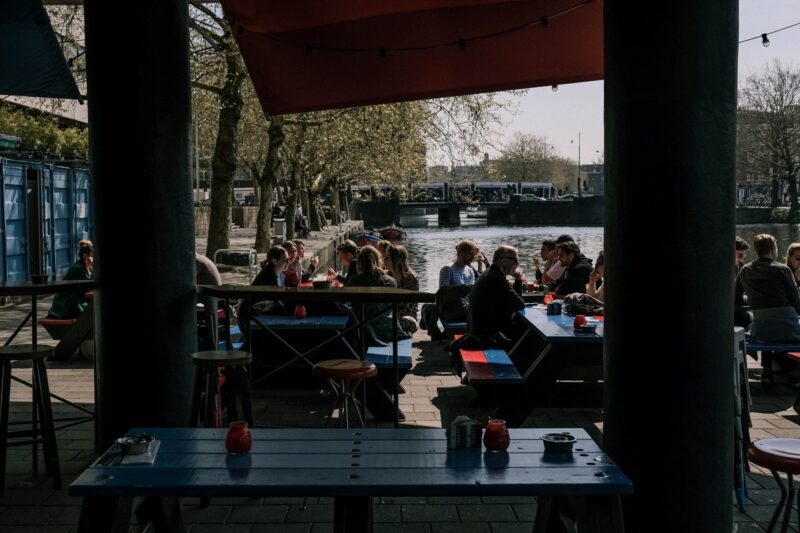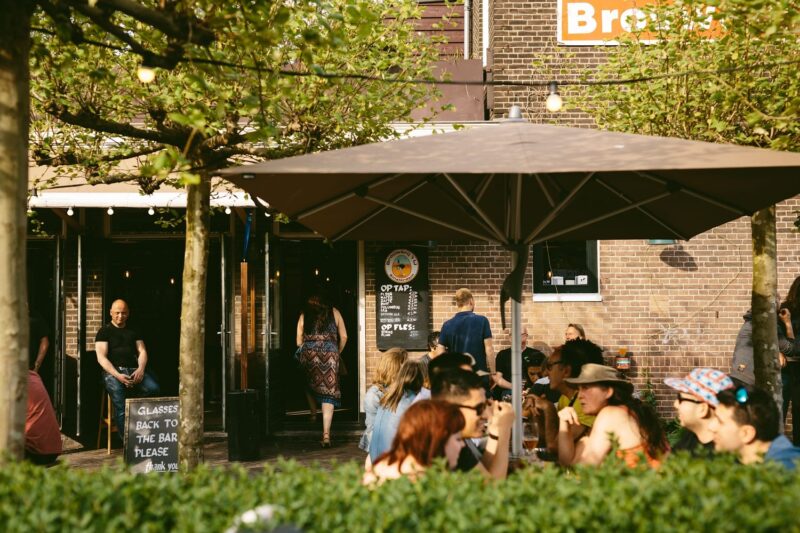
Indische Buurt isn’t the version of Amsterdam that most travellers come here to see. As the famous canals fan out of the city centre in concentric horseshoe shapes, they seem to skip this neighbourhood entirely. There are none of the cobbled, tourist-filled streets packed with cheese shops, or hawkers selling clogs and dirty postcards that are commonplace around Dam Square. Nor are there the pricey boutiques of De 9 Straatjes or the Red Light District’s mix of Gothic beauty and neon-lit streets teeming with drunken stag weekends, coffee shops, and bored looking women in windows.
However, the Indonesian District is as typical of Amsterdam as any of these things, if not more.
Sitting at the heart of Zeeburg, built on an artificial island east of the city centre and sandwiched between the Lozingskanaal to the north and the hipster hub of De Pijp to the west, Indische Buurt is a vibrant, multicultural neighbourhood that perfectly encapsulates the Dutch mindset of inclusivity and liberalism.

Down Dapperstraat we weave in and out of shoppers. White tents contain trestle tables stacked high with fruit and veg, clothing and trinkets. The 100-year-old Dappermarkt – a swathe of over 250 stalls cutting through the centre of Zeeburg – proudly displays the melting pot that is modern-day Amsterdam; You are just as likely to find vendors selling saris and dashikis as you are traditional greengrocers and stalls flogging cheese.
We huddle around a table at the far end of the market, peering into the fogged glass as a woman scoops fried Kibbeling – a dish of deep-fried, battered fish – into a paper tray. She squirts a dollop of garlic sauce beside the grease-laden pieces of golden whiting and we munch away at a meal so traditionally Dutch, while surrounded by displays of beautiful African and Middle Eastern fabrics.


As a market, it has had to evolve to serve the community that surrounds it. Amsterdam is a complex mix of different ethnicities. One study that I read claims 52% of the city’s residents are foreign-born or 2nd generation migrants – the 8th highest of any city in the world. However, the city being a magnet for migrants is nothing new. Since the end of the 80 Years War and following Dutch independence, they have been known for their tolerance to outside cultures and religions. Soon, Huguenots from France, Jews from the Iberian Peninsula and Flanders painters came to the area, as well as religious refugees from Spanish-controlled areas of the Low Countries. These first-wave immigrants helped Amsterdam to prosper into the 17th century, bringing on the city’s golden age. It was during this time that it became the richest city in the world and the centre of a worldwide trading network, with the Dutch setting up colonies across the world.
With that in mind, It seems fitting that I met Agnes outside of the Tropenmuseum, a museum originally set up in order to show Dutch overseas possessions and items from foreign cultures, such as Indonesia and Suriname. Agnes is a tour guide for Urban Adventures, her tours focussing on ‘immigration and examining Amsterdam’s proud history of welcoming settlers from all over the world‘. She’s softly spoken with an accent that’s hard to place; part Northern Irish, part Dutch with a sprinkling of other vocal twangs for good measure. She meets me with a smile despite my late, sweaty arrival, having to hail an Uber from the central station and then spending 10 minutes wandering around the wrong entrance of the Tropenmuseum.
Agnes feels that the city is so much more complicated and interesting then is presented to tourists, that it is underselling its culture to its own detriment. She wants to give visitors the chance to move beyond the very beautiful, yet in someways hollowed-out centre of the city for a few hours of their stay. As an immigrant herself, examining Amsterdam’s inclusive nature and history of welcoming settlers is a perfect fit.
She describes herself as having an itinerant childhood, born in Germany of British parents, moving to the Republic of Ireland as a young child and then spending her teens in Holywood, near Belfast. In her own words, she has itchy feet;
“I kind of wandered into Amsterdam for a year with my then-boyfriend (they had been living in Bristol) because he could do a quality masters here affordably – and in English – which in itself says a lot about what the Netherlands, and especially Amsterdam, is like. Apart from personal circumstances, the lifestyle and culture in this city kept me here. It’s peaceful, non-confrontational but very direct, anything feels possible. You can cycle everywhere, safely and with ease. And I have learned to appreciate their flair for excellent infrastructure. I guess the Netherlands links the different parts of my childhood to each other, they even exported the Orange men to Ulster.”
Her passion for Amsterdam is clear as soon as we begin the tour. She crouches beside a flagstone near Alexanderplein, its surface etched with a map of the city’s waterways, centuries-old layout and former city walls. She excitedly points around the city’s outline, explaining how Dutch ingenuity reclaimed the land around the IJ, transforming what was once marshland into a thriving port and bustling metropolis. It was this ingenuity and engineering skill that allowed the Dutch to profit from the slave trade, creating colonies in countries like Suriname and Indonesia. As problematic as a brutal colonial past is, particularly for a nation as socially aware and as liberal as the Netherlands, it is something that has shaped the country dramatically. Migration from the colonies began during the colonial era, but it wasn’t until the 20th century that it boomed. Between 1945 and ’65 around 300,000 Dutch, Mollucans and Indo people, the descendants of mixed Dutch and Indonesian parents, left Indonesia for the Netherlands. Just before the declaration of independence, many Surinamese people started to emigrate to the Netherlands.

In the centre of Oosterpark stands a monument depicting a cluster of bronze figures. The National Slavery Monument. Those at the back emaciated and shackled together, representing slavery’s dark and dramatic history. The next group represent breaking through the wall of resistance in the modern-day, and the person leading the pack is shown elevated in the air, arms outstretched, representing the longing for freedom and a better future. The Netherlands officially abolished slavery in the colonies of Suriname and the Dutch Antilles in July 1863. 139 years later, in 2002, Surinamese sculptor Erwin de Vries was selected to design the Slavernijmonument. Despite the monument being a small recognition of some of the countries past atrocities, it wasn’t without controversy. As Queen Beatrix unveiled the statue in the presence of only a handful of dignitaries, the public was kept at bay, including those Dutch people from the Antilles and Suriname that campaigned for the monument to be created.
Currently, more than 300,000 Surinamese people live in the Netherlands, with a huge number of them residing in Amsterdam. To get a feel for why these people decided to emigrate and start a new life in Amsterdam, Agnes plays us a recording of a conversation with her friend, Sophia A-Tjak-Hiwatm, a Surinamese immigrant that moved to the Netherlands in the ’70s. Sophia explains that she didn’t have a great start in life; at 12 years old, she became ill with heart problems. At 15 years old, she was told that she could no longer go to school as her parents couldn’t afford both the school bills and hospital treatment.
“I thought ‘oh my god, I want to be a teacher, how can I stop school? I want to live! So I wrote a letter to my brother – I have one brother here in Holland. Without telling my parents, I sent a letter to him asking if he can pay for my books. He sent a plane ticket for me. In two weeks I had to leave Suriname and I’m still here. I wasn’t going to stay. I thought maybe I could get surgery and then I could go back to my family because I missed them a lot, I was so lonely here.” In the beginning, maybe the first 10 years, I thought ‘okay, I’m going to go back to Suriname’ because there were not a lot of Surinamese people here. In ’76 they came here because of the independence of Suriname. At the beginning, I was thinking that I was going to go back, but then I thought ‘no! I have one chance. You’re not going to get a lot of chances. and then I met my husband. And then we married. Had children. Then I decided to stay here and choose Holland. That’s why I decided I was going to stay here, but not forget about my country because I had my sister there, my family.”
Sophia A-Tjak-Hiwatm is now about 60 and lives in the South East of Amsterdam, in the Bijlmer. It is a neighbourhood that was created as an innovative Modernist approach to urban design, led by architect Siegfried Nassuth. Ultimately, its aim to attract middle-class Dutch families failed and the project collapse. However, the government found a use for it; Following Suriname’s independence in 1975, many of its inhabitants migrated to the Netherlands and the government placed a substantial number of them in affordable social housing in the Bijlmermeer. Today it houses almost 50,000 people of over 150 nationalities. Once again it shows the Dutch using their initiative to make the best of a bad situation; Just like they transformed the silty dirt of the IJ into a prospering city, they transformed a failing housing project into a place that 10’s of thousands of immigrants can call home.
Agnes is fairly vocal about her love of the Dutch way of thinking and I find her enthusiasm contagious. She gives me an example, describing how, at first glance, you can look out along the flat, rural Dutch landscape and mistake it as one single piece of land. The dykes and ditches that divvy it up into smaller plots are hidden. Compare this to the rest of Europe, where imposing hedgerows and fences separate each field or section of farmland. Without saying too much, it perfectly encapsulates the country’s approach to migrants.
That isn’t to say that immigration in Holland isn’t without its perceived issues and Sophia A-Tjak-Hiwatm is well aware of that.
“In the 70’s there were not a lot [of immigrants]. There were just some people from Suriname and Antilla. Later on a lot of people came because of the independence of Suriname. Then you see a lot of change because just like now, people are saying “oh, they’re going to take our jobs”. They said the Surinamese were lazy that we don’t want to work, that we are slow and we don’t fit in the society. Then there was a period that they were accepted but now you see the same again. they say “it’s too much now, Holland is full.”
It’s an issue that came to a head in 2004 when Dutch filmmaker, Theo van Gogh, who made a controversial film about Islamic culture, was stabbed and shot dead in Oosterpark by Mohammed Bouyeri, a Dutch-Moroccan Muslim who objected to the controversial film. Agnes walks us towards a statue called ‘De Schreeuw’ (the scream), erected near to where van Gogh was murdered. His death shocked the Netherlands, sparking debates on freedom of expression, free speech and inevitably, immigration.
“We need to meet the refugees, organise meetings to show them how we live here and what our values are. I’m not saying that they don’t have values, but in Syria or in Suriname, you live differently, you know? Especially when we have the gay parade. They say “oh we can not go into the city centre”. No, here we are free. If you don’t like this, then why did you come to Amsterdam. You want everybody to be themselves, and I like that. Why do you want to be in a country but not accept their values?”
Luckily for the people of Amsterdam, Sophia A-Tjak-Hiwatm practices what she preaches. As well as running Stichting Congada, a foundation for women with chronic illnesses, she is very socially engaged and involved with community projects. She even ‘adopted’ a Syrian refugee with whom she has a very strong relationship, welcoming him into her home and treating him as if he is family. Agnes explains that she knows him very well, and he sees Sophia as a second mother.

After our eye-opening look at slavery and colonisation, I’m pleased when Agnes walks us to Zeeburg, promising to show us a neighbourhood that thrives on its multiculturalism.
Amsterdam Oost is as far removed from the city centre’s gabled townhouses and cafe-lined canals as you can get. Instead, it consists of low-slung apartment blocks on reclaimed industrial land. It is a far cry from the city’s cheesy Red Light District and pretty canals. It has always hosted an eclectic mix of people from across the Dutch diaspora, most notably the Indonesian migrants that flooded here following the countries proclamation of independence, giving the area its name: Indische Buurt, or the Indonesian District. Nowadays, many of the Indonesians have moved outwards, further from the city centre, but multiculturalism remains central to Zeeburgs identity.

As we walk along Javastraat we see shopkeepers topping up their displays of fresh fruit and veg, Turkish supermarkets serving freshly baked baklava and people crowding into cafes for plates of steaming Indonesian street food. Alongside them, hip young Amsterdammers gather outside and bistros, sipping their flat whites and topping up their tans. As city centre rents continue to soar, first time buyers, students, and startups have headed this way, bringing a buzz with them. Yet, the neighbourhood seems to sit in that perfect spot, before gentrification starts to kick in.
Now, cool bistros sit alongside Surinamese restaurants and vintage markets are nestled next to hardware stores and international supermarkets. At the moment it has something for everyone, the boutiques clustering on Javastraat, Middenweg and Czaar Peterstraat luring in visitors from across the city while the very same streets still cater to locals and immigrants alike.


To see this for ourselves, we first head into a shop selling Indian wedding attire, the walls strewn with a rainbow of shimmering, colourful saris, each intricately embellished with patterns of gold and silver. Beneath the glass counter are display cases filled with vibrant beads and gems and every inch of wall space is taken up with shelves of shiny ribbons or beautiful jewellery.
We then step inside Tigris & Euphrates, a local supermarket and delicatessen specialising in products and delicacies from the Middle East. The owner, Adel, is an Iraqi immigrant himself and in recent years, he has been gradually building up his stock of Syrian products. He hopes to provide familiar foods to the influx of refugees. I’m amazed by the variety as I wander the aisles; a huge range of olives – dozens of different types – or 5 different brands of honey from Syria alone. There’s tahini, sahlab and Aleppo soap. All of them are imported directly from the middle east with labels of origin listed as places like Baghdad, Damascus and Mosul.


As well as his imported products, Adel has a packed deli counter serving up falafel, mezze and Syrian baklava, its sugary pastry glistening behind the glass. To wash down my incredible baked delicacies, Adel passes me a cup of brown liquid that he dispenses from a slushy machine. It is the colour and consistency of the river IJ but I slurp it down nonetheless and I’m pleasantly surprised. It’s sickly sweet, almost syrupy, but incredibly moreish. As much as I could stay inside Tigris & Euphrates all day, sampling each one of its treats, we say our goodbyes to Adel and head for our final stop, across the Lozingskanaal to the city’s Jewish Cultural Quarter.

The Kweekschool has an important history of helping the downtrodden and oppressed. Following the Nazi occupation, Jewish families were gathered in the Dutch Theatre opposite to await their fate, usually being deported to concentration and extermination camps. Often, parentless children were sent to the nursery situated next to the Kweekschool. The Nurseries director, Henriëtte Pimentel, soon started rescuing children. They were smuggled across the rear courtyard to be hidden in the Kweekschool or bundled onto trams by nursery staff.
Today the building is home to Ondertussen, an art studio and cultural space that provides a working environment for artists and designers with a refugee background. We’re met at the door by Nino Zalica, the self-styled host and caretaker of the studios, who arrives panting and out of breath from the 4 flights of stairs that he has descended to greet us. The building itself is a rabbit warren of rooms. Nico passes each one, reeling off the names of whatever artist or writer is currently occupying the space. He lists Estonian artists, Russian painters, Syrian drummers, journalists, architects and photographers.


Nino is himself an immigrant artist, arriving from war-torn Sarajevo. When his short film, ‘Angels in Sarajevo’ was shortlisted for a European Film Academy’s Felix Documentary Award in 1994, he travelled to Amsterdam for the ceremony and eventually stayed. As well as being a filmmaker he is also a writer, penning novels, plays and poetry, although now he spends much of his time working with the international group of artists and creative entrepreneurs at Ondertussen.
We gather around a table in the buildings communal kitchen area to hear Nino’s story and learn about the Ondertussen. The idea of the project is to provide recent arrivals to Amsterdam with a space to create their art, whether that be painting, writing, design or journalism. Each refugee is paired with a local artist to help them assimilate in the city and have a contact in the local art scene. Such is the popularity of the project that they are now having to be particularly picky with applicants, only giving space to the most talented of artists.

On the afternoon that we are visiting, most of the offices and studios are vacant but Nino manages to seek out Julia Kiryanova, a Russian painter hard at work in a room on an upper floor, splattered with every colour of paint imaginable. Next door we see some work in progress from another one of the resident artists; beautiful images painted entirely using coffee and gold.


I finish the tour standing on the rooftop of the Kweekschool with Agnes and Nino, overlooking the Plantage Middenlaan and Hollandsche Schouwburg. It feels the perfect place to end, looking at a building synonymous with Nazi occupation and oppression while within the confines of a building that aims to support refugees and help them flourish.
I have been to Amsterdam a few times now, and on each visit, I have wandered the canals, strolled around De 9 Straatjes and hung out in Dam Square. I have drunk in the Red Light District, frequented the museums and got lost in the gothic, cobbled alleys. Despite this, I hadn’t seen the real Amsterdam. I hadn’t experienced the multiculturalism, the inclusiveness and the liberalism that has defined the city for centuries. Like millions of other tourists to the city, I had just seen a version of Amsterdam that I thought I wanted to see. Now, at least, I was a little closer to knowing what Amsterdam is truly about.
Like Agnes says: “The city is so much more complicated and interesting then it is presented to tourists… Amsterdammers have taught me a lot about different possible ways of living together and I am excited to share a little of that with visitors to the city too.”
Disclaimer: In order to write this blog post, I was provided with an Amsterdam In Focus tour free of charge by Urban Adventures. However, all views expressed are my own.
To book the Amsterdam In Focus tour, head over to the Urban Adventures website.