Sitting at the end of the line as the last stop on the old Great Western train route, the market town of Penzance has seen its fortunes come and go throughout the centuries. Its historic streets echo with tales of smugglers, pirate invasions, and ghoulish ghost stories, but it has been a long time since buccaneers roamed the Penzance quayside and even the tourist trade that boomed in the 19th century thanks to the arrival of the railway has steadily declined.
I have seen an abundance of articles in the past describing Penzance as ‘Cornwall’s coolest town’ or bestowing it with unmerited hipster credentials which, despite the town steadily gaining a more bohemian and artsy reputation, is a slight overstatement. West Penwith’s largest town is a far cry from the pretty streets of St. Ives, the Michelin stars of Padstow, and the creative buzz of Falmouth.


At its heart, Penzance is the typical English port town; a windswept seaside resort where bundled up families shield their salt and vinegar-soaked chips from curious seagulls; a town that sees visitors flock during the summer season but empties out in the winter months when storms batter the promenade and waves rush over the sea wall; a town that has, like many of the UK’s other resorts, seen decades of decline due to an increase in overseas tourism.
Thankfully, Penzance’s fortunes are on the up. It doesn’t hurt that it is inarguably pretty – filled with grand Georgian architecture (Regent Square, Chapel Street and North Parade spring to mind), gorgeous granite buildings, and containing two lush public gardens – which undoubtedly helps paper over some of its rougher edges while the growing artistic scene has fostered a community of vibrant independent boutiques, galleries, cafes and restauraunts, some of which may even rival what is on offer in Cornwall’s more established culinery hotspots.

Noteworthy places are popping up all of the time and although Penzance may not challenge its more post-card worthy neighbour St. Ives in the coolness stakes, it is on its way thanks to the bounty-filled vintage shops, fantastic art galleries and recently refurbished Jubilee Pool. Yes, it may not be Cornwall’s coolest town just yet, but it is on its way and deserves to feature in your Cornish holiday itinerary.

The Best Things to do in Penzance
1. St Micheal’s Mount
2. Jubilee Pool
3. Mackerel Sky Seafood Bar
4. Chapel Street
5. The Admiral Benbow
6. Mousehole
7. Newlyn
8. Trengwainton Garden
9. Newlyn Art Gallery
10. Vintage Shopping<
Walk the Watery Causeway to St. Michael's Mount
While the waterfront of Penzance is rocky and uninviting, strewn with black-and-sand coloured pebbles that dig into your heels and strain the arch of your foot, the stretch of coastline that makes up the eastern reaches of Mounts Bay is much more enticing; a wide ribbon of sodden, golden sand that is swallowed by the rising silvery-blue tide, often windswept with a lingering scent of salt and seaweed. Here you will find the craggy coves of Piskies, Prussia, and Kenneggy before eventually reaching the rugged coastline of the Lizard.
However, it’s the section of coastline beside the village of Marazion that appeals to me the most. On its own, it is not particularly interesting, especially when compared to the crashing waves of Lands’ End or the foreboding cliffs and white sands at Porthcurno and Pedn Vounder, but just a few hundred metres out to sea, across a causeway that is only revealed at low tide, St. Michael’s Mount rises dramatically from the water and gives this stretch of sand one of the most stunning backdrops found in the entire UK.
The abbey that tops the Mount – known locally as Karrek Loos yn Koos or ‘the grey rock in a wood’ – has existed in one form or another since the 5th century, although its current form wasn’t constructed until the 12th. It was built by the same order of Benedictine monks responsible for the building’s sister abbey, Mont St-Michel, in Normandy.

Throughout the centuries, the Mount has changed hands on countless occasions, acting as a castle, prison, barracks and family home. It is still owned by the St Aubyn family who took charge of the Mount after buying it in 1659, but the day-to-day running is undertaken by the National Trust despite the fact that the Lords St Levan remains seated here. Thanks to the National Trust’s involvement, you can now explore the mount, first visiting the small village at the castle’s base (around 30 islanders still live here, travelling to the mainland for schools, shopping and work) before making your way up through the island’s lush, sub-tropical gardens and entering the castle itself where you will find extravagantly decorated rooms, an armoury. and a beautiful 14th-century chapel.
At high tide, you will need to catch a boat from Marazion to visit the Mount, but as the water recedes you are able to walk across the cobbles of the hidden causeway, much as pilgrims have done since the monastery was first constructed.
Dive Into Art Deco At The Jubilee Pool
The frigid waters of the Jubilee pool in Penzance have been delighting holiday makers since it opened in 1935 to celebrate King George V’s Silver Jubilee.
Sitting on the tip of Penzance’s ‘Holy Headland’, this Art Deco gem is one of the few saltwater, tidal, open-air swimming pools in the world. It has earned grade II listed status thanks to its graceful curves and fairly unique shape. The Pool was built upon Battery Rocks near Penzance Harbour, previously a traditional bathing spot, and was designed with a triangular shape to withstand the ferocity of Cornish storms and waves.
The pool itself is only re-filled with water (5 million litres of the stuff) during the high spring/summer tides which occur around once a fortnight.

The Jubilee pool fell into disrepair in the last few decades of the 20th century, eventually succumbing to storm damage 2014. Thankfully, the operation of the pool was taken over by Jubilee Pool Penzance Limited, a community-run social enterprise in the form of a charitable Community Benefit Society. Repairs were made and £1.8m of funding was raised to allow year-round opening and the construction of a new geothermal pool which extracts warm water from a 410m deep geothermal well before re-injecting the cooler water back into the ground. It is the first of its kind in the UK.
Booking for the geothermal pool is essential but the colder, seawater pool usually has spaces available.


Although the pool now dominates the majority of battery rocks, headland surrounding it is still used by locals and tourists as a launching point for swimming in the surrounding sea. Walk the perimeter at any time of day and you will see it being used by the pensioners of local wild swimming groups and as a playground for boisterous teenagers alike.
Tuck Into Some Delicious Seafood
Although Penzance doesn’t quite have the culinary clout of some of Cornwall’s other seaside towns – with the Rick Stein-dominated dining scene in Padstow, the star chefs of Port Isaac, and the cosmopolitan harbourside cafes of St. Ives stealing much of the limelight – it still manages to hold its own when it comes to restaurants. Seafood is where Penzance shines, which is no surprise when you consider that it is adjacent to some of the richest fishing grounds in the Northern Hemisphere and the county’s busiest fishing port, Newlyn Harbour, with its adjacent fish market is right on Penzance’s doorstep.
While dining options range from simple chippies and greasy spoons to pricey fine dining establishments, my humble opinion is that the cosy Mackerel Sky Seafood Bar, just a stone’s throw from the harbour at the heart of Newlyn, provides Penzance’s premier seafood experience. More a whitewashed beach shack than a typical restaurant, this cute café first opened its doors in 2015 and aims to bring only the freshest fish and most local of ingredients to its customers, serving simple but delicious dishes such as salt & pepper squid with aioli, grilled mackerel, succulent Cornish mussels, and plump scallops with Cornish dukkah in a tapas style, giving you the opportunity to sample multiple plates during your visit.
Mackerel Sky does not take bookings and due to its tiny size, arriving early is essential as the queue for a table begins to curl out of the café and across Newlyn’s high street shortly after opening.
Opening Times: 12 pm – 9 pm daily

Delve into Penzance's History on Chapel Street
Mid-eighteenth century Chapel Street is one of Penzance’s oldest thoroughfares and a boon for history lovers. Extending up from the quayside to Market Jew Street, this picturesque, narrow lane was almost completely burnt to the ground in 1595 with the rest of Penzance by a marauding force of Spanish musketeers seeking revenge for the humiliating defeat of the Spanish Armada just 7 years before. The street was rebuilt and by Georgian times, was lined with grand homes that still stand today. It is in one of these houses that Maria Branwell lived – she was the mother of Charlotte, Anne, Emily, and Branwell Bronte (marked by a plaque on no.25 Chapel Street).
Opposite is The Turks Head Inn, Penzance’s oldest pub (built around 1233) and one of the few buildings to survive the 1595 raid. However, its neighbouring Boozer, the Admiral Benbow is a little more interesting. Named after the 17th century Admiral John Benbow, the pub is also famed for featuring in the opening scene of Treasure Island by Robert Louis Stevenson and houses a fascinating collection of maritime artefacts rescued from shipwrecked vessels. You will find more information on the Benbow and its smuggling past below.


By the 19th century, Penzance’s lawlessness was mostly under control and as a result of the town’s booming sea trade, a number of nations located their consulates on Chapel Street; the Portuguese, Spanish, Dutch, French and Ottoman Empire all moved representatives here.
In a street of extravagant buildings, the Egyptian House is probably the most eye-catching. Its impressive geometric facade, built in 1835 to house the collection of the celebrated mineralogist, John Lavin, is Grade-I listed due to it being a rare example of Egyptian Revival architecture from the 1830s that was all the rage thanks to Napoleon’s campaigns in Egypt.
Across the street from the Egyptian House, beside a jumble of fantastic clothng and craft shops, you will find another historic drinking spot. The Union Hotel once housed an early Georgian theatre and Assembly Rooms where the town’s gentry would meet. Its claim to fame is that it was here that the victory of the battle of Trafalgar was announced – alongside news of the death of Admiral Horatio Nelson – by Mayor Thomas Giddy. It was local fishermen who first heard of the victory after intercepting HMS Pickle on her return to Falmouth.
Have a Pint in a Historic Smuggler's Tavern
It’s no secret that Cornwall has a historic, almost mythical, connection with smuggling and in no other town was this more lucrative than in Penzance. During the golden age of smuggling – thought to be around 80 years between 1750 and 1830 – the people of Penzance had little regard for King or government due to the raising of import taxes, which led to a rise in seedy, illicit trade all along the West Penrith Coast. Of all the smuggling gangs to rise to prominence in these parts, the Benbow Brandy Men of the Admiral Benbow pub were the most notorious.
They based their operations in this Chapel Street pub – funnily enough, directly opposite the town’s customs house – using a series of tunnels to sneak booze and tobacco up from the harbour, directly under the noses of excise men. The tunnels beneath the pub remain (although are now blocked) alongside one other reminder of the Brandy Men’s misdeeds; a carved wooden figure that can be seen lying prone on the rooftop, a gun pressed to his eye aimed directly at across the narrow street. It is said to represent smuggling chief Octavius Lanyon, who climbed onto the roof to battle the authorities during a revenue raid. Local legend claims that he was eventually shot down.
One of the town’s oldest watering holes, the Benbow has existed since the 17th century and is even name-checked in Robert Louis Stephenson’s ‘Treasure Island’ as the home of Jim Hawkins. Stephenson visited Penzance in 1880 and although had almost finished the novel, had not yet decided where to begin his story. After a few drinks in the Admiral Benbow – which was very much an illegal drinking establishment run by smugglers at the time – he decided to include it in his book.


Nowadays the interior of the Benbow is kitsch and cluttered, which is a large part of its appeal. Beneath its 17th century beams it houses a treasure trove of eclectic marine memorabilia, a fascinating collection of wreckage and maritime artefacts rescued from numerous shipwrecked vessels which foundered on the Cornish coast during the last 400 years. You will find diving equipment and oil lamps, flags and figureheads. Even an old cannon. In the ‘Captain’s Cabin’ restaurant at the back of the pub you can find woodwork from a Portuguese Man O’ War ship, giving diners the impression of being onboard a centuries old craft.
It’s the Admiral Benbow’s legendary status and significance that has seen it recieve a Heritage Pub Status certificate in 2016 from CAMRA in recognition of ‘outstanding historic importance’.
Walk The South West Coastal Path to Mousehole
If you stand on Penzance’s promenade you will find yourself on a section of the South West Coastal Path, the UK’s longest established National Trail that stretches for 630 miles and encompasses the entire coastline of Cornwall. Luckily, the get to Mousehole, you only need to walk a 3-mile section of the trail, climbing the steep hill past Newlyn Harbour and around Mousehole’s jutting headland.
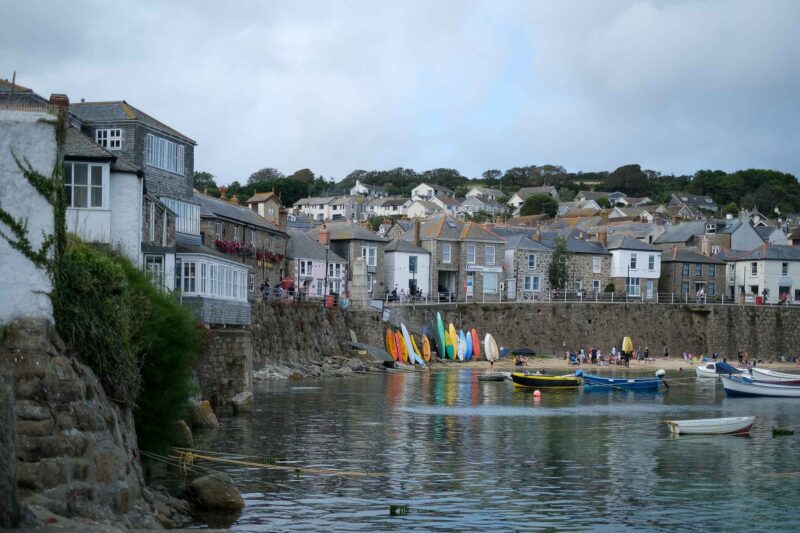
Once described by the poet Dylan Thomas as “the loveliest village in England”, Mousehole is no longer the quiet fisherman’s hamlet that it was when he honeymooned here with Caitlin Macnamara in 1937 and now many of the whitewashed cottages that line the cobbled lanes are packed with holidaymakers throughout the year. The harbour that stands at the foot of the village rings out with the sound of splashing children and teens leaping from the harbour walls on balmy summer days.
This doesn’t mean that Mousehole is any less pleasant though; its beautiful streets are narrow and twisting, most of them leading to the waterfront where at low tide the boats slump on the seaweed-covered mud. As it rises, they bob languidly on the crystal-clear water. From the benches outside the Ship Inn, where Thomas stayed after he wed, sitting with a pint of bitter watching the boats come in, St. Michaels mount glittering in the sunlight across Mount’s Bay, it is easy to see why he thought of the village so fondly.

Explore Neighbouring Newlyn
Usually unexplored by the most tourists who see it as nothing more than an industrial thoroughfare on their way to Mousehole’s picture-perfect harbour, Newlyn will surprise you. At first glance, the tag of industrial fishing town seems to fit Newlyn perfectly; the enormous fishing port clatters with the sound of swaying rigging and spluttering engines while each morning men in saltwater-soaked waders and heavy wellies stack colourful plastic crates overflowing with fish on the floor of the bustling fishing market. However, the town is undergoing rapid evolution and embracing the independent shops and eateries that are emerging to carry on where Newlyn’s established fishing industry has left off.
In the town’s burgeoning restaurant scene, local produce and a traceable supply chain are key with eateries such as the Mackerel Sky Seafood Bar and the Tolcarne Inn, a 300-year-old whitewashed pub in which the chalkboard menu changes daily depending on what is available at the market.
While you’re in Newlyn, ensure that you stop off for a drink at Lovetts, a much-loved neighbourhood coffee shop by day where you can pick up a fancy cheese toasty to go alongside your flat white that transforms to an organic wine bar come evening time, serving up cocktails and local craft beers alongside their range of low-intervention wines. Newlyn’s culinary delights don’t stop here either. Recently opened Newlyn Fermentary on The Strand collaborate with local growers and produce fermented vegetables, even offering workshops and classes in fermentation while Newlyn Cheese & Charcuterie has an enormous selection of cold cuts and speciality cheeses, as well as bread from the popular local bakery, Vicky’s Bread.
Relax in Lush, Sub-Tropical Gardens
With its mild coastal climate, Cornwall is home to some of the UK’s most spectacular sub-tropical gardens. While the likes of Trebah, Geldurgan and Trelissick get most of the plaudits (and the visitors), this leaves Trengwainton Garden, just outside of Penzance, as somewhat of a hidden gem.
The garden at Trengwainton was started in the 19th century but didn’t begin to shine until the early 20th century when the Bolitho family began to import exotic plants from Asia. Now run by the National Trust, the narrow gardens consist of a half-mile-long stretch of woodland filled with magnolias, camellias and the rhododendrons that ends at a terrace with views that, on a clear day, reach 25 miles across Mount’s Bay to the Lizard peninsula beyond.
In Penzance town itself is the much more compact Morrab Gardens, a secluded three and a half acres of subtropical garden that works its way from the centre of town to the seafront. The stucco villa that sits in the centre of the gardens was purchased by Penzance council in 1888 with the house becoming the Morrab Library and the gardens opening their gates to the public.


Visit the Local Galleries
Art and the British seaside are intrinsically linked in many ways. Some say that the abundance of light, the dreamy sunsets and wide-open skies draw artists coastwards in their droves while others may be attracted to the drama and ferocity of the ocean itself. It’s no surprise that J. M. W. Turner spent his entire life capturing the character of the sea and that towns like St. Ives, Margate and Falmouth have all become creative hubs. Thankfully, Penzance is following closely on their paint-speckled heels with myriad contemporary galleries as well as its fair share of small, independent exhibition spaces.
The jewels in its artistic crown are the twin Galleries of Newlyn Art & The Exchange, split across Penzance and neighbouring Newlyn. Newlyn Art Gallery – overlooking the harbour and occupying the former home of journalist John Passmore Edwards – is well-established on the scene, founded to showcase and support the landscape work of Newlyn School artists over 120 years ago, and remains one of the region’s most highly regarded art spaces with a rotating schedule of contemporary and populist work.
In 2008 they expanded to open The Exchange. Housed in the town’s former telephone exchange, The Exchange has a distinctly industrial feel with its enormous glass façade that runs the entire length of the building. Here, Newlyn Art Gallery aims to bring world-renowned contemporary works to Penzance alongside community-based exhibitions.
If you prefer to experience your art alfresco, Tremenheere Sculpture Garden’s perfectly hewn landscape filled with palm trees, succulents, and bamboo provides a perfect backdrop for artworks by Internationally and nationally renowned artists such as James Turrell, Kishio Suga, David Nash, and Tim Shaw. The permanent pieces are scattered throughout the garden’s lush valley which looks out which over St Michael’s Mount, whose monks owned the land at Tremenheere until 1295 when it was bought by Michael De Tremenheere, an established tenant farmer.
Shop for Retro & Vintage Treasures
Wander the back streets, secluded alleyways and hidden staircases of Penzance and you’ll stumble on all manner of shops-cum-treasure troves dealing in splendid antique or vintage items. Daisy Laing Gallery and Vintage Furniture Store on Chapel Street has a wealth of 20th century pieces ranging from desks and office chairs to magnificent floor lamps, some of which date back to the 1920s. This corner of Chapel Street appears to be a hub of stylish boutiques with a cluster of shops selling stylish homeware, art prints and second-hand vinyl. Clothing and crafts shop No.56 is a personal favourite. For vintage clothes, you can’t do much better than Pin Up Boutique on Market Jew Street.


Your shopping in Penzance shouldn’t be restricted to antiques and timeless furnishings though; the town has plenty of fantastic independents selling all manner of items. I could have spent hours browsing the shelves at the wonderful Edge Of The World Bookshop and while it is much smaller, Barton Books has a well-curated stock of fiction, non-fiction, and coffee table art books.

Where to Stay in Penzance
Whatever your budget, Penzance isn’t short on accommodation options; The prominade is lined with Bed and breakfasts or wallet-friendly hotels, while the backstreets have a good range of boutiques and AirBnb’s that will suit the more discerning traveller.
Artist Residence
This creative yet unpretentious hotel oozes bohemian vibes. The rooms are filled with vintage or repurposed furniture – think coffee crate tables and Rajasthani wall hangings – giving an artsy feel to the property. The hotel has its own boho bar lounge, restaurant, banquet room and beer garden. There are film nights on Tuesdays during the winter months.
Chapel House
Set within a 1790s Georgian townhouse was owned by Admiral Samuel Hood Lindsay, Chapel House is was transformed by Susan Stuart and architect Keith Bell who transformed the building into a stunning boutique hotel. Both beautifully modern but embracing period styles, the hotel’s ‘open house’ philosophy makes it friendly and inviting. If you’re staying here, take full advantage of the supper club, where Susan whips up mid-week suppers for guests on request.
YHA Penzance
A YHA property is always a cheap, reliable option when travelling and YHA Penzance is no different. Located in a stunning Georgian mansion set within magnificent grounds, it has all the amenities you will need for large group or solo trips such as a licensed bar, café and games room. Both dorm beds and private rooms are available.
Getting to Penzance
By Pubic Transport
There are direct GWR trains to Penzance running regularly from London Paddington, passing through Reading and Exeter as well as the more lavish Night Riviera Sleeper for overnight journeys. Trains journeys from the midlands and further north are a little more arduous, usually involving changes at Taunton or Newton Abbot.
A cheaper alternative is to use National Express, who run coaches from many major UK cities.
By Car
Penzance is relatively easy to reach by road. After travelling by motorway to Exeter, join the A30 and continue on here until you reach Penzance. The route is well signposted once you are in West Cornwall. From North Devon, you can opt to take the scenic A39 Atlantic Highway until you reach the A30 at Chiverton Cross.
Parking in Penzance
Penzance isn’t short of parking spaces with the council operating several short and long-stay car parks around the town, the main car park being the Harbour Long Stay Car Park beside Penzance Railway Station. Seven and fourteen-day tickets are available to buy online that allow you to park in council-run car parks around the town.
There is limited on-street parking along the seafront but spaces fill quickly during the summer.